Layflat photo books, explained: when the upgrade actually makes sense
 by Ashley Carter– 7 years of experience in photo gifts and home deco
The honeymoon spread you've been picturing for months: the sweep of a beach at sunset that runs the full width of an open book, no spine break slicing through the horizon. Or the wedding portrait you want printed twelve inches tall, edge to edge, with both your faces uninterrupted by a binding gutter. These are the moments where binding stops being a technical detail and starts shaping how the memory feels in your hands.
A layflat photo book is the answer when standard binding falls short. The pages lie completely flat when opened, so a single image can span both sides of the book without losing anything to the spine. Some print shops spell it as one word, others list it as "lay flat photo book," and a few call the same product a layflat photo album: the binding works the same way regardless. It's the format pros choose for albums that need to look gallery-finished, the kind of premium photo book you build when one of your photos really has to land. Below, you'll find a clear guide on when the premium binding is worth it, when our standard hardcover is the smarter pick, and how to plan a layflat photo book that does your photos justice.
In this guide, you'll learn:
- What Makes a Layflat Photo Book Different from a Standard Album
- Layflat Binding vs Standard Hardcover: Which Photo Book Fits Your Photos?
- When a Layflat Photo Book Is Worth the Upgrade
- How to Choose the Right Layflat Photo Book Size and Cover Finish
- How to Order Your Layflat Photo Book in 4 Steps
At a glance: A layflat photo book is the premium choice for panoramic spreads, wedding albums, and travel keepsakes where you want photos to cross the spine without a break. It costs more than our standard Custom Photo Book, but the seamless two-page spreads and thick rigid pages deliver a gallery-quality finish that everyday photo albums can't match. For most family memories, our standard hardcover wins on value; for milestone moments, layflat pays off.
What Makes a Layflat Photo Book Different from a Standard Album
A layflat photo book is built so every spread opens completely flat, with no curve at the spine and no gutter loss across the center. That single structural difference changes everything about how you can design the book.
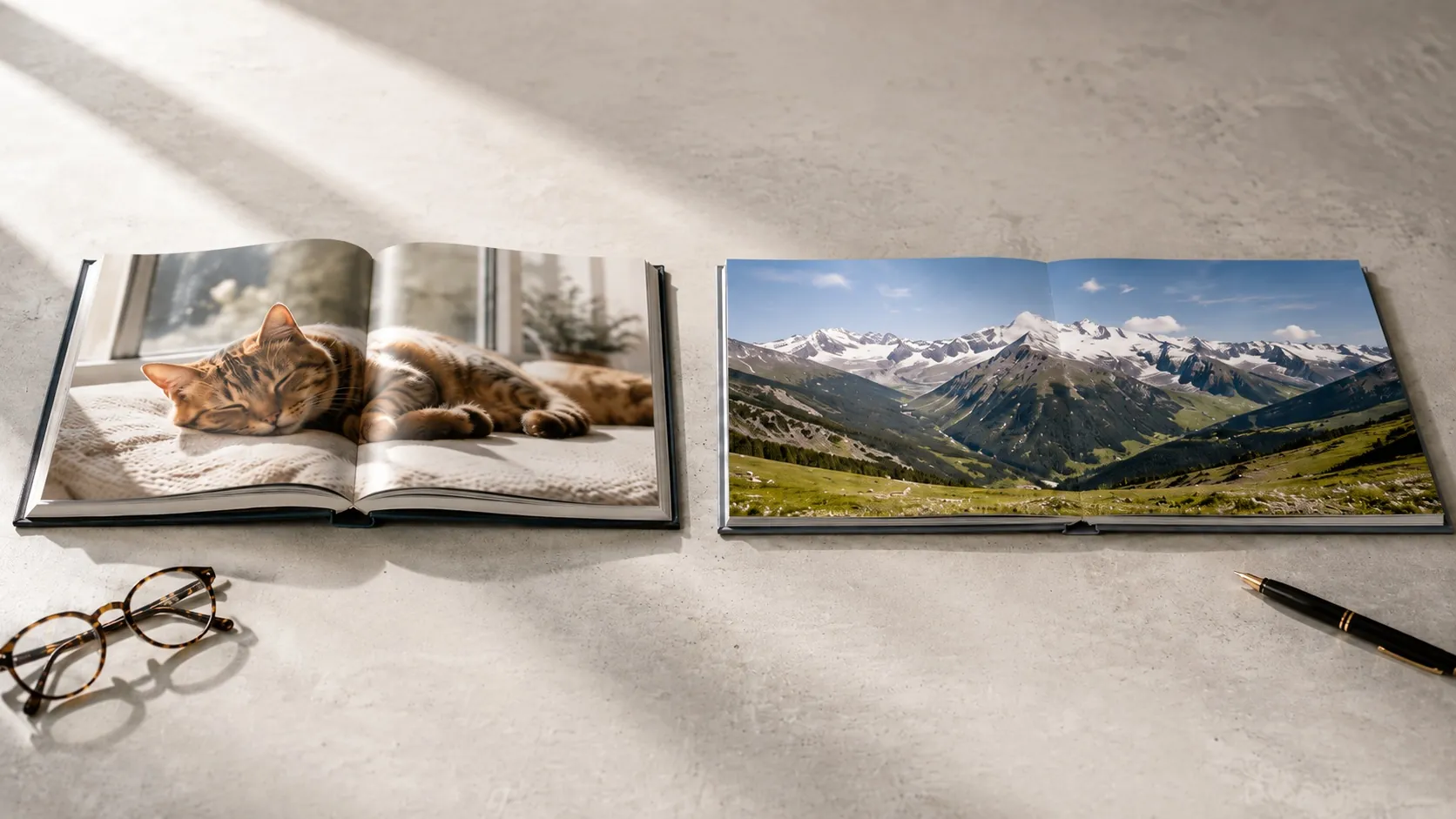
In a standard hardcover photo book, the pages are bound at the spine the same way most hardbacks are. When you open the book, the inner edge of each page curves into the binding. Any photo you place across both pages loses a slim band in the middle, and the book naturally wants to close on its own. That's perfectly fine for most family albums, where each page holds its own photo or a tidy grid.
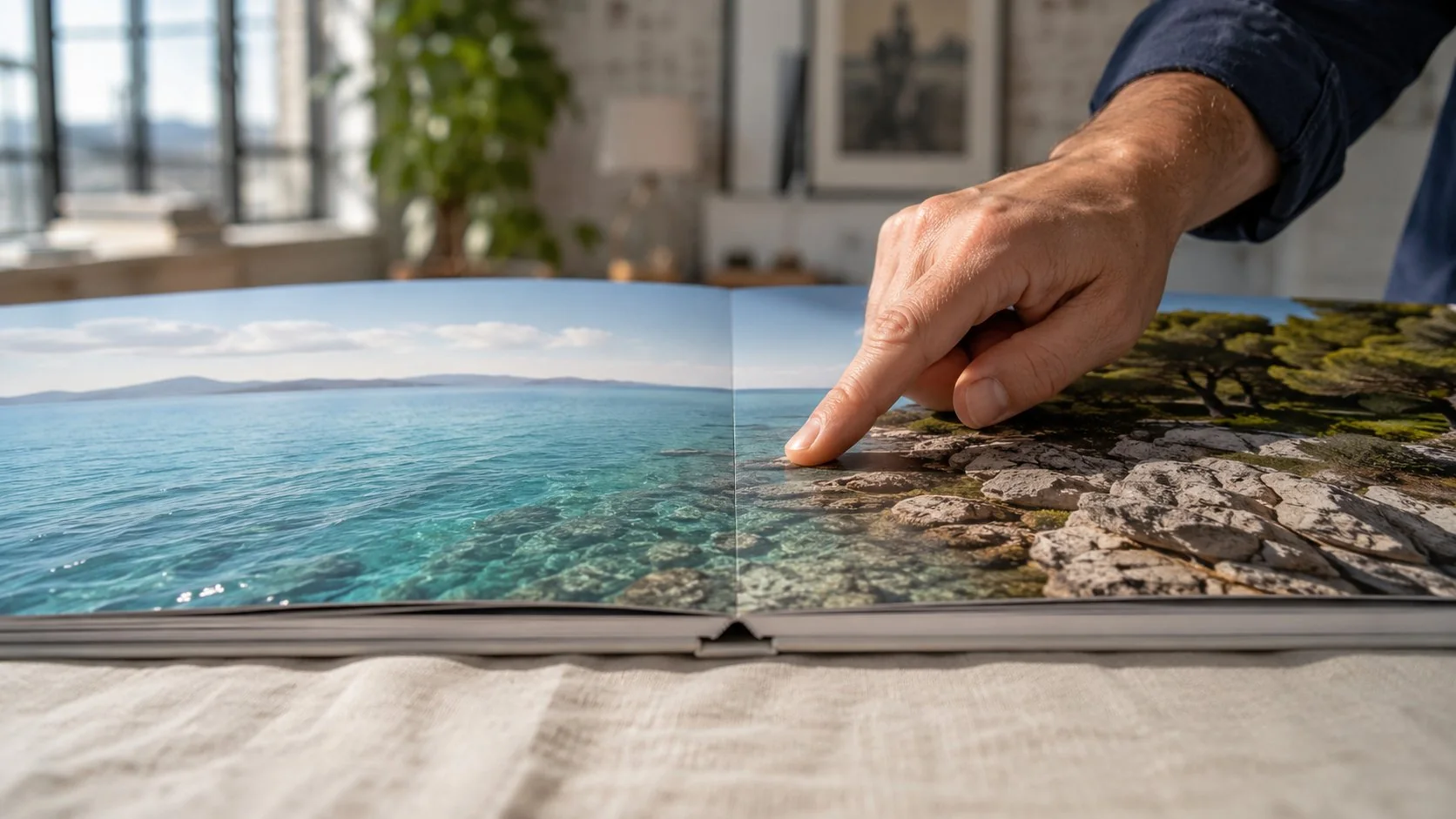
Layflat binding works differently. Each pair of pages is printed back to back and bonded together at a hinge, so the spread sits as a single rigid surface. When you open to any page, both sides settle perfectly flat on the table. The book stays open by itself. You can print a single photo at the full width of the spread, mountain to mountain, with no spine break and no compromise.
This is the binding wedding photographers use for client albums. It's the format travel pros pick when they want their landscapes to feel cinematic. And it's the choice you'll want for any project where the photo itself is the hero and you can't afford to lose detail to the gutter.

A few practical differences to know upfront:
- Page thickness. Layflat pages are noticeably thicker and stiffer than standard pages, which makes the book feel more substantial in your hands.
- Open behavior. Layflat books stay open on their own; standard hardcovers want to spring shut.
- Maximum spread size. Layflat opens to twice the page width as a continuous canvas; standard binding effectively limits you to single-page photos with small bleed across the spine.
- Page count flexibility. Standard photo books typically allow many more pages at a friendlier price; layflat books are usually designed for shorter, curated stories.
- Price tier. Layflat is the premium binding. Our standard Custom Photo Book scales generously across page counts; layflat-style upgrades sit in a higher tier built for milestone projects.

Our recommendation: If your project leans on full panoramic spreads or you're building a once-in-a-lifetime album, the layflat upgrade is the right call. For everyday family books, our standard hardcover photo book delivers excellent quality at a far friendlier price.
Layflat Binding vs Standard Hardcover: Which Photo Book Fits Your Photos?
The choice between a layflat photo book and a standard hardcover photo book comes down to how you want your photos to read on the page. If you've designed your layouts around single photos per page or tidy collages, standard binding is the better value. If you've built spreads around panoramic shots that demand to cross the spine, layflat earns the upgrade.
Here's how the two compare side by side on the criteria that actually matter when you're deciding:
| Criteria | Layflat Photo Book | Standard Hardcover Photo Book | QuickBook |
|---|---|---|---|
| Page behavior | Lies completely flat | Curves slightly at spine | Curves slightly at spine |
| Two-page spreads | Seamless, no gutter loss | Small gutter break in center | Small gutter break in center |
| Page thickness | Thick, rigid, cardstock-feel | Standard photo paper | Standard photo paper |
| Page count | Shorter, curated stories | Generous, flexible page counts | Fixed page count |
| Best for | Wedding albums, travel keepsakes, portfolios | Family yearbooks, vacation recaps, baby books | Quick gifts, last-minute projects |
| Design effort | High, every spread is a layout | Medium, page-by-page | Low, drag-and-drop template |
| Price tier | Premium | Mid-range | Mid-range |
A few notes on how to read that table:
The QuickBook is included because it's a real third option a lot of readers compare against, especially when time matters more than depth of customization. Our QuickBook is designed to get a polished photo book in your hands fast, with a simplified workflow and a curated template. It's the right pick when you have a deadline (a birthday next week, a baby shower coming up) and you don't want to sweat every spread.
If you want the flexibility to build every page exactly the way you envision it, the standard Custom Photo Book is the workhorse. It's the format that gets the most use across weddings, vacations, baby books, and family yearbooks. You get full control over layouts, backgrounds, captions, and page counts.
Layflat binding belongs in a different conversation. It's not really competing with the standard hardcover on price or page volume. It's competing for the emotional weight you'd otherwise get from framed prints or a gallery wall. When you hand someone a layflat album, they can tell the difference in the first three seconds.
When a Layflat Photo Book Is Worth the Upgrade
A layflat photo book is worth the premium when the photos themselves demand it: panoramic landscapes, wedding portraits, fine-art portfolios, and any project where a single image needs to span both pages without a visible break. For everyday family albums and vacation recaps, a standard hardcover delivers nearly the same emotional impact at a much friendlier price.
Here are the scenarios where layflat pays for itself:
- Wedding albums. The first dance, the ceremony arch, the group photo with both families: these are images you'll want printed wide and uninterrupted, with the kind of paper weight that signals "keepsake" the moment someone picks it up.
- Travel and landscape books. Wide-angle shots of mountains, coastlines, cityscapes, and architecture all read better as panoramic spreads. A gutter break across the Grand Canyon is a hard thing to forgive.
- Portfolios and proof books. If you're a photographer, designer, or visual artist showing work to clients, layflat is the binding that signals professionalism. The flat presentation also means clients can really study each image without fighting the curve of the spine.
- Milestone gift books. Retirement tributes, anniversary albums, memorial books for a loved one. When the book itself is the gift and the photos are the message, the upgrade is worth it.
- Baby's first year, beautifully done. A standard Custom Photo Book is the smart pick for most baby books, but if you want the first-year album to become a generational keepsake, layflat earns its keep.
When standard hardcover is the smarter call:
- Family yearbooks and vacation recaps where you're organizing dozens of small photos per spread.
- Holiday gift books for grandparents who'll flip through them often (those thick layflat pages aren't fragile, but standard pages are more forgiving of heavy handling by little hands).
- High page-count projects where you want to fit 80 or 100 pages without the cost climbing into another bracket.
- Budget-conscious gifts where you want the photo book experience without the premium price tier.
Our recommendation: Start your project in our standard Custom Photo Book builder. As you lay out your spreads, ask yourself how many of them really need to cross the spine seamlessly. If the answer is more than three or four, the layflat upgrade is worth the conversation.
How to Choose the Right Layflat Photo Book Size and Cover Finish
The right size for a layflat photo book depends on how you want the album to be read: held in two hands like a novel, opened across a coffee table like a portfolio, or displayed flat on a console like a piece of decor. Larger formats reward panoramic content; smaller formats are easier to gift and handle.
A few size rules of thumb to guide your choice:

- Smaller squares (around 8x8 inches). Great for compact gift albums, baby's first year, or a focused trip recap. Easy to hand off, easy to store on a bookshelf, and the lower page-count cost stays friendly.
- Mid-size formats (10x10 or 12x12 inches). The sweet spot for wedding albums and travel books. Big enough that panoramic spreads feel cinematic, small enough that the book is still pleasant to hold and pass around at a dinner table.
- Large landscape formats (around 12x10 inches or wider). Built for portfolios, fine-art projects, and any book where you want the open spread to feel like a gallery wall. Best displayed on a console or coffee table; not the format you flip through casually.
Cover finish matters more than most people expect. The cover is the first thing someone touches, and it sets the tone for everything inside:
- Hard photo cover. Your own image wrapped across the front, full-bleed. The most personal option, ideal for wedding albums and gift books.
- Linen or fabric-feel cover. Quiet, textural, and timeless. Works beautifully for memorial books, milestone albums, and anything where you want the cover to whisper rather than shout.
- Matte vs. glossy pages. Matte is the safer pick for portraits and editorial layouts because it kills reflections and reads more refined. Glossy gives you punchier color saturation and works better for vivid travel and landscape books.
Layout choices matter just as much as size. If you're investing in layflat binding, build at least a few true two-page spreads to justify the upgrade. A book with twelve perfectly executed full-spread images often reads more powerfully than a book with sixty single-page photos. Edit ruthlessly. The layflat format rewards restraint.
For a deeper walkthrough on building the layouts themselves, our step-by-step guide to making a photo book online covers the design workflow in detail, from photo selection to final proof.
How to Order Your Layflat Photo Book in 4 Steps
A layflat photo book is the kind of project worth slowing down for. Here's how to move from a folder of photos to a finished album you'll be proud to hand over.
- Step 1: Curate your photos before you start designing. Pull together every photo you might want to include, then cut the selection in half, then cut it in half again. A great layflat album typically uses 40 to 80 photos, not 200. Look for variety: wide establishing shots, mid-range moments, intimate detail crops, and at least four to six images strong enough to anchor full two-page spreads. Quality always wins over quantity in this format.
- Step 2: Plan your spreads before you upload. Open a blank document or grab a notebook and sketch out which photos belong together. Identify the four to six images that will get the full layflat treatment and reserve the best spreads for them. Group the rest by chapter or theme: getting ready, ceremony, reception; or travel day one, day two, day three. This planning step takes 30 minutes and saves hours during the build.
- Step 3: Build your book in our online editor. Upload your photos, choose your size and cover finish, and lay out each spread with intention. Drag your panoramic shots into the full-spread layout slots first, then fill in the supporting pages around them. Use generous white space; the layflat format breathes better when you don't crowd every page. Preview every spread at full size before you move on.
- Step 4: Proof carefully, then order. Walk through the entire book one spread at a time. Check that no important faces or details land in the binding area. Confirm captions for spelling. Verify that every full-spread image is high enough resolution to print sharp at large size. Then place your order through the builder, and let our team handle the printing.
Tip: If this is your first photo book project, build a small test book first using the QuickBook format. A 20-page test run helps you calibrate your photo-selection instincts before you commit to a full layflat album.
The Bottom Line on Layflat Photo Books
A layflat photo book is the premium binding for premium moments. It earns its higher price when your photos demand seamless two-page spreads, when the album itself is the gift, and when you want a keepsake that feels gallery-finished the moment someone opens it. For everyday family memories, our standard Custom Photo Book delivers excellent quality at a friendlier price; for once-in-a-lifetime projects, layflat is the upgrade that pays for itself in how the book reads, feels, and lasts.
The bottom line: Choose layflat when at least three or four of your spreads need to cross the spine seamlessly; choose our standard hardcover when you want flexibility, generous page counts, and the best value.
Frequently Asked Questions
-
A layflat photo book is a premium binding format where every spread opens completely flat, with no curve at the spine and no gap interrupting two-page images. The pages are thicker and stiffer than standard photo book pages, and the book stays open on its own without being held.
-
A layflat photo book is worth the upgrade when your project includes panoramic spreads, wedding portraits, or any image you want printed across both pages without a gutter break. For family yearbooks and everyday vacation recaps, our standard Custom Photo Book delivers excellent value without the premium price.
-
Standard hardcover books are bound at the spine like a novel and curve slightly when open, losing a small band of any image that crosses the center. Layflat binding uses thicker, rigid pages glued spread-by-spread so the book opens completely flat, letting single images span both pages seamlessly.
-
For wedding albums and travel books, 10x10 or 12x12 inches is the sweet spot, large enough for cinematic spreads but still pleasant to hold. For smaller gift albums or baby books, 8x8 inches is more giftable; for portfolios and fine-art projects, go larger.
-
Most great layflat photo books land between 40 and 80 photos across 20 to 40 spreads. The format rewards editing: a tight, well-curated album reads more powerfully than a long one. Save the high page counts for our standard hardcover photo books.
-
Yes, and you should. Use full two-page spreads for your strongest panoramic and portrait images, then fill the rest of the book with single-page photos and tasteful collage layouts. The contrast between spreads and single pages gives the album rhythm.
-
Production and delivery timing varies by project size and shipping method. Build in extra time if you're ordering for a specific occasion like an anniversary or wedding gift, and place the order at least two to three weeks ahead of any hard deadline.
