There is a fear that sits at the heart of every cheap canvas prints search: "What if it arrives and looks terrible?" You picture a flimsy frame, washed-out colors, and canvas so thin you can see daylight through it. And to be fair, that fear is not entirely unfounded. Some budget canvas prints are genuinely awful. But here is what most people do not realize: the price of a canvas print has very little to do with its quality once you know what to look for. The difference between a cheap canvas that looks stunning and a cheap canvas that looks like a dollar-store poster is not the price tag. It is the printing process, the materials, and the photo you upload. Get those three things right and a budget canvas print is virtually indistinguishable from one that costs three times as much.
This guide explains exactly what determines canvas print quality, how to spot the warning signs of a bad printer, and how to get gallery-quality results without paying gallery prices.
What Actually Determines Canvas Print Quality
Price is a terrible proxy for quality in the canvas print industry. Some companies charge premium prices for average products because their brand name allows it. Other companies produce excellent results at lower prices because their operations are efficient and their margins are honest. The factors that actually determine whether your canvas print looks cheap or looks stunning have nothing to do with what you paid.
Whether the Materials Are Published at All
The first thing to check is not a material. It is whether the company is willing to name one. A printer that tells you what the canvas is made of and how the frame is built is a printer you can hold to a standard. CanvasDiscount canvas is 100% polyester, and the floater frame range is made from 100% recycled ocean plastic. You cannot assess canvas quality from a website photo, but you can assess a company's willingness to describe its materials in detail. Companies that are vague about what they are selling are usually vague for a reason.
Independent Testing
This is the one quality signal a company cannot award itself. Testing by an outside laboratory for harmful substances means someone other than the seller has examined what ends up on your wall. CanvasDiscount canvas prints are independently tested for harmful substances. It is worth more than any adjective on a product page, and it matters most in nurseries and children's rooms, where people scrutinise what they bring indoors.
The Ink System
CanvasDiscount prints with HP Latex ink, which is solvent-free. That makes the prints suitable for children's rooms and for households with allergy sufferers. Not every printer uses the same chemistry, and it is the quality variable most consumers never think to ask about. If a company will not tell you what it prints with, treat that as information in itself.
The Stretching and Framing
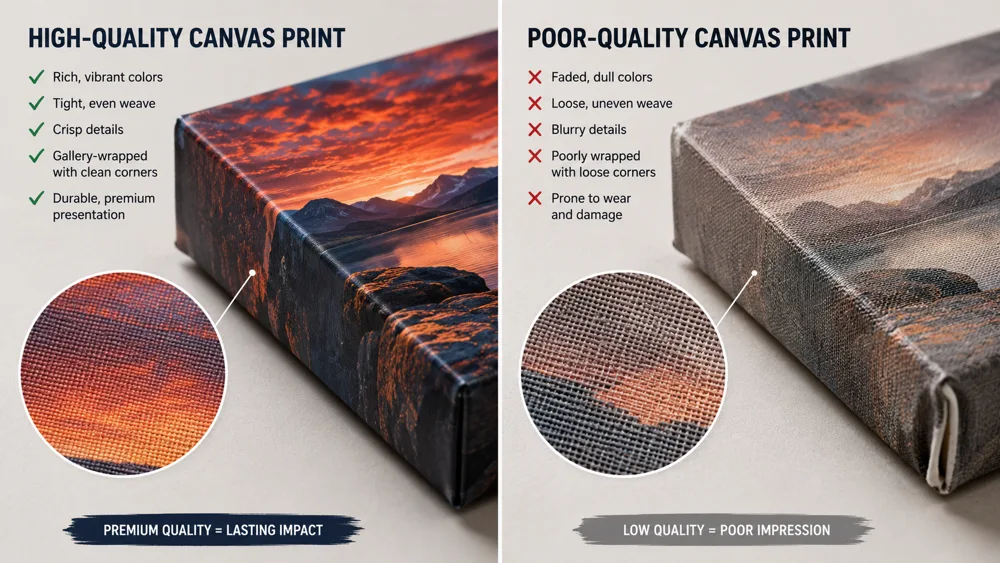
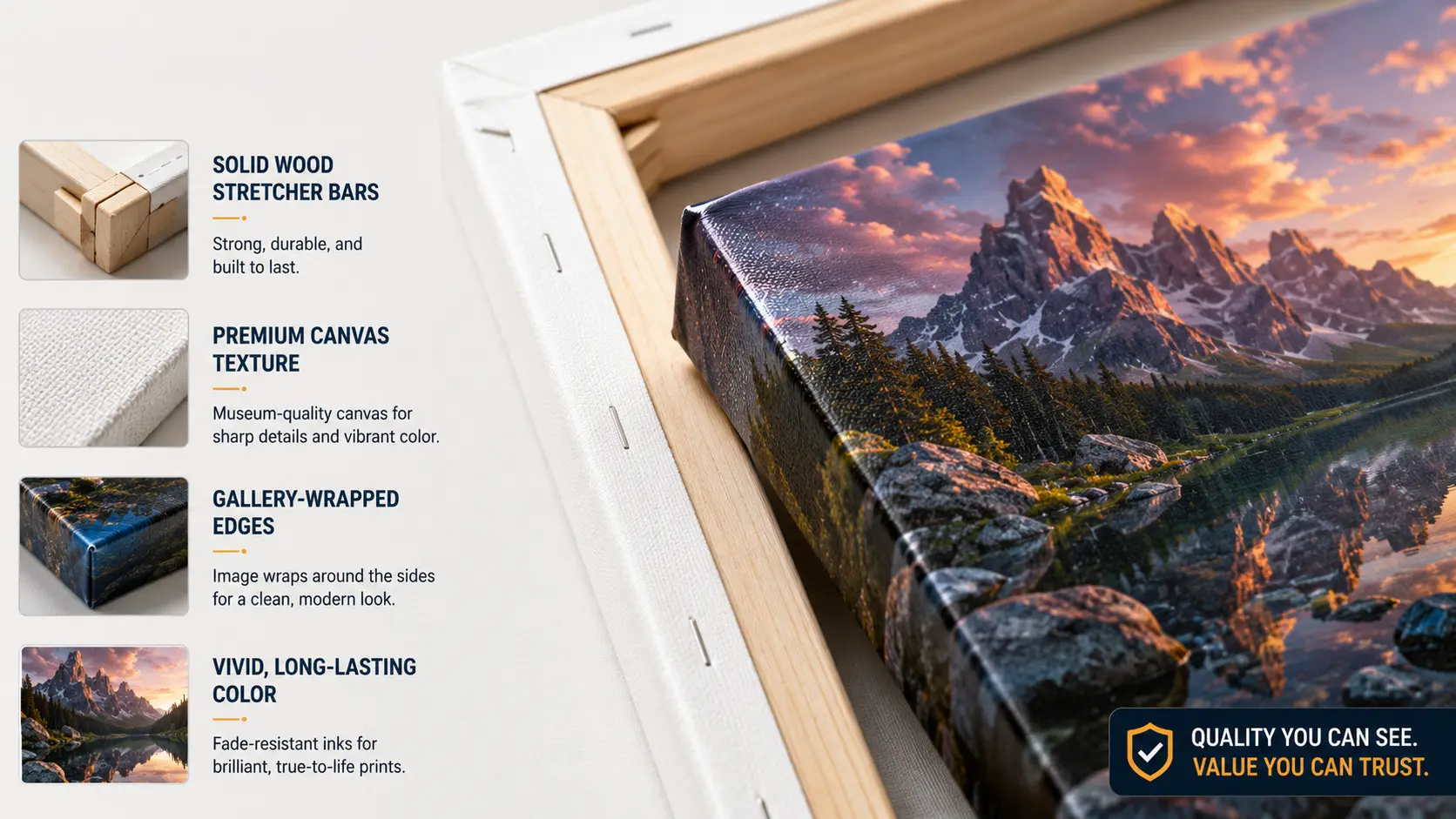
A well-stretched canvas is taut, even, and holds its shape over time. A poorly stretched canvas sags, wrinkles at the corners, and develops a wavy surface that distorts the image. What to look for is construction: precisely joined corners, a frame that feels rigid, and bracing on larger sizes. Gallery-wrapped edges (where the image wraps around the sides) should be clean and evenly stretched, with no bunching or staple marks visible from the front. CanvasDiscount offers a Classic 2cm (3/4") depth and an XXL 4cm (1 1/2") depth.
Color Accuracy
The difference between a canvas print that looks "off" and one that looks professional is usually color calibration. Good printers calibrate their equipment regularly so that what you see on screen is what you get on canvas. Bad printers run uncalibrated equipment that shifts colors unpredictably: skin tones go orange, blues go purple, greens go muddy. This is the quality issue that makes cheap prints look cheap, and it is entirely a production problem, not a price problem.
The Quality Checklist: What to Look for Before You Order
Green Flags (Order With Confidence)
✔ Company publishes what the canvas and the frame are made of
✔ Independently tested for harmful substances
✔ Solvent-free latex ink, stated plainly
✔ Recycled-content frame construction
✔ A published minimum resolution for each product
✔ Gallery-wrapped edges standard
✔ Color accuracy guarantee or satisfaction policy
✔ Free or low-cost shipping options
✔ Tens of thousands of reviews on an independent platform
✔ Production location stated openly
✔ Easy-to-use online preview tool
✔ Clear return and reprint policy
Red Flags (Proceed With Caution)
✘ No material details anywhere on the site
✘ Prices that seem impossibly low (under $10 for large sizes)
✘ No customer reviews or only generic testimonials
✘ No preview tool showing your image on the product
✘ Vague or nonexistent return policy
✘ Shipping takes 3 to 4 weeks (suggests overseas production)
✘ Stock photos used instead of real customer examples
✘ No information about the ink system
✘ No independent testing mentioned anywhere
✘ Contact options limited to email only
How to Get the Best Results From a Budget Canvas Print
Even the best printing company in the world cannot fix a bad photo. The single most important factor in whether your canvas looks premium or looks amateur is the image you upload. Here are the rules that separate stunning budget prints from disappointing ones.
Resolution Is Everything
Canvas prints magnify your image, which means they magnify flaws too. For canvas the minimum is 72 dpi at print size, and acrylic, metal, framed prints and posters need 120 dpi. More resolution than the minimum still produces noticeably better results. In practical terms, a photo from any smartphone made in the last three to four years will have enough resolution for canvas prints up to 30x40 inches. Problems arise when people crop heavily, zoom into a small portion of an image, or try to print photos from social media (which compress resolution significantly). Always upload the original file, not a screenshot or a download from Instagram.
Lighting Makes or Breaks the Print
Photos taken in good natural light produce the best canvas prints at any price point. Indoor photos taken under artificial lighting often have a yellowish or bluish color cast that canvas amplifies. If your best photo was taken indoors, use a free photo editor to correct the white balance before uploading. The thirty seconds this takes can transform the final result.
Simple Compositions Print Best
A single clear subject with a clean background will always look better on canvas than a cluttered scene with competing focal points. This is especially true at budget price points, where the printing process may slightly soften fine details. A bold landscape, a tight portrait, or a single striking object will look gallery-worthy. A busy group photo taken from thirty feet away in mixed lighting may not.
Leave Room for the Wrap
Gallery-wrapped canvas prints fold the image around the sides of the frame. This means roughly half an inch to an inch of your image wraps around each edge and is not visible from the front. Keep important elements (especially faces and text) away from the very edge of your photo. Most canvas print ordering tools show a preview with the wrap area indicated, so check this before confirming.
Smart Sizing: Where Budget Meets Impact
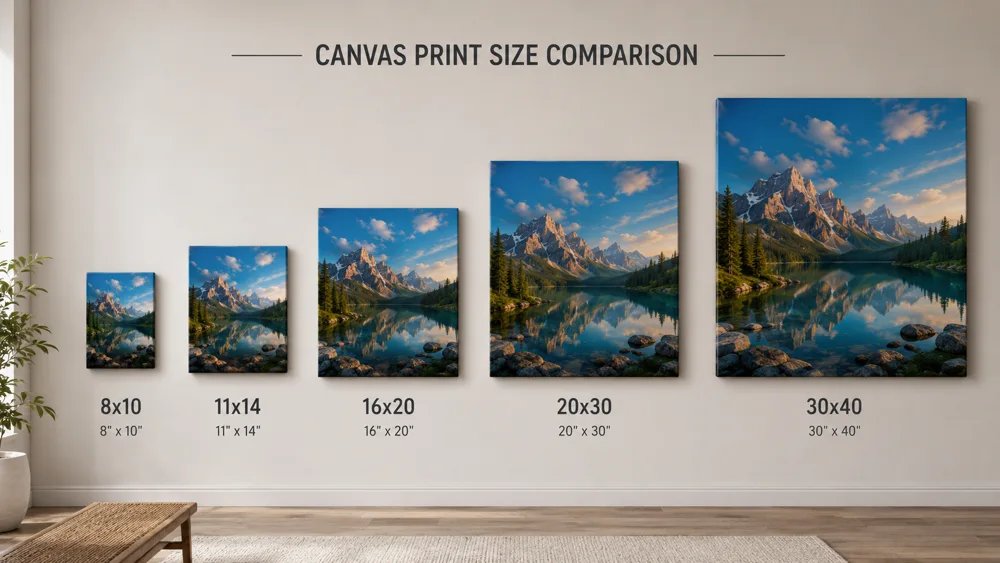
One of the easiest ways to get more value from a budget canvas print is choosing the right size for your space. Bigger is not always better, and smaller is not always cheaper per unit of visual impact.
| Canvas Size | Best For | Value Rating | Budget Tip |
|---|
| 8x10 to 12x16 | Desks, shelves, small walls, gifts | ★★★ | Great for testing a printer before committing to larger sizes |
| 16x20 to 20x24 | Bedrooms, offices, secondary walls | ★★★★★ | The sweet spot: large enough to impress, priced to stay affordable |
| 24x36 | Living rooms, above sofas, feature walls | ★★★★ | Best cost-per-impression ratio for primary wall art |
| 30x40 and larger | Statement pieces, large living rooms, lobbies | ★★★ | Wait for promotions or bundle deals for the best large-format value |
| Multiple small (gallery wall) | Hallways, staircases, creative arrangements | ★★★★ | Several smaller canvases often cost less than one oversized piece |
The 16x20 to 20x24 range consistently delivers the best value. It is large enough to make a visual impact on any wall, small enough to keep the price firmly in budget territory, and the resolution requirements are forgiving enough that almost any smartphone photo will print beautifully. For more guidance on building a multi-canvas display, read our guide on how to make a gallery wall.
Budget Canvas Print Strategies That Actually Work
Knowing how to get the best price without sacrificing quality is a skill, and it is simpler than most people think.
Money-Saving Tips for Canvas Prints
1. Use coupon codes. Most canvas print companies, including CanvasDiscount, offer regular promotions and coupon codes. Check the website before ordering, as discounts of 20% or more are common and can reduce a $50 canvas to under $40.
2. Order during sales events. Black Friday, holiday weekends, and seasonal promotions routinely offer the deepest discounts. If your order is not urgent, waiting a week for a promotion can save significant money.
3. Consider a collage canvas. A single collage canvas with multiple photos costs less than ordering several individual prints and creates a more dynamic visual effect.
4. Size strategically. A 16x20 at a budget printer often looks better than a 30x40 at a bad printer. Invest in quality at a manageable size rather than stretching your budget for maximum dimensions.
5. Decide which add-ons you actually want. A standard gallery-wrapped canvas is a complete product on its own. Upgrades such as a floater frame or the hanger set are worth paying for when you want them, but they are choices rather than requirements.
How CanvasDiscount Delivers Quality at Budget Prices
Not every budget canvas printer delivers the same quality, and understanding what separates a reliable provider from a risky one matters when you are spending real money. CanvasDiscount canvas prints use solvent-free HP Latex ink on 100% polyester canvas, stretched with gallery-wrapped edges, and they are independently tested for harmful substances. Production is in the United States, and the rating is 4.8 out of 5 across more than 60,000 reviews. The online design tool shows a real-time preview of your image on the canvas, including the edge wrap, so you know exactly what the finished product will look like before you order.
For a detailed breakdown of canvas costs and what affects pricing, see our guide on the best canvas prints for tight budgets. And if you are deciding between canvas and other wall art materials, our comparison of canvas vs metal vs acrylic prints covers the full landscape.
Conclusion
A cheap canvas print does not have to look cheap. The price you pay determines the company's margin, not the quality of the product on your wall. What determines quality is what the company is willing to disclose and have tested, the ink system, the stretching process, and above all, the photo you upload. Get those right and a budget canvas print delivers the same visual impact as a premium product at a fraction of the cost. Use the quality checklist in this guide to evaluate any printer before ordering, choose the right size for your space, upload a high-resolution photo with good lighting, and you will get a result that looks like it belongs in a gallery, not a clearance bin. Great wall art does not require a great budget. It requires the right knowledge, and now you have it.
Frequently Asked Questions
Are cheap canvas prints good quality?
They can be. Canvas print quality depends on the printing process, the ink system, the materials a company is willing to publish, and stretcher bar construction, not just the price. Budget printers that disclose their materials and submit to independent testing produce results comparable to premium-priced competitors.
What makes a canvas print look cheap?
The most common causes are poor color calibration (resulting in unnatural tones), thin canvas that shows the weave, flimsy stretcher bars that warp over time, and low-resolution images that appear blurry when printed at large sizes.
What resolution do I need for a good canvas print?
For canvas, the minimum is 72 dpi at print size. Acrylic, metal, framed prints and posters need 120 dpi. Most smartphone photos from the last few years clear these comfortably for prints up to 30x40 inches when you upload the original file.
How can I get the best deal on canvas prints?
Use coupon codes, order during sale events, consider collage canvases instead of multiple singles, and choose the 16x20 to 20x24 sweet spot for best value. CanvasDiscount also runs a price guarantee, so a lower price found elsewhere is worth raising before you order.
Is the ink safe to hang in a child's room?
CanvasDiscount prints with HP Latex ink, which is solvent-free. That makes the prints suitable for children's rooms and for households with allergy sufferers, and the prints are independently tested for harmful substances. If you are ordering elsewhere, ask what ink system is used, because not every printer uses the same chemistry.