Wedding Photo Album Ideas: How to Create a Photo Book You’ll Love Forever
 by Ashley Carter
 7 Minutes
Your wedding day is done. The guests have gone home, the flowers are wilting, and the cake is long gone — but somewhere on a photographer’s hard drive, thousands of photos are waiting. Now comes the question almost every couple faces sooner or later: what do you actually do with them?
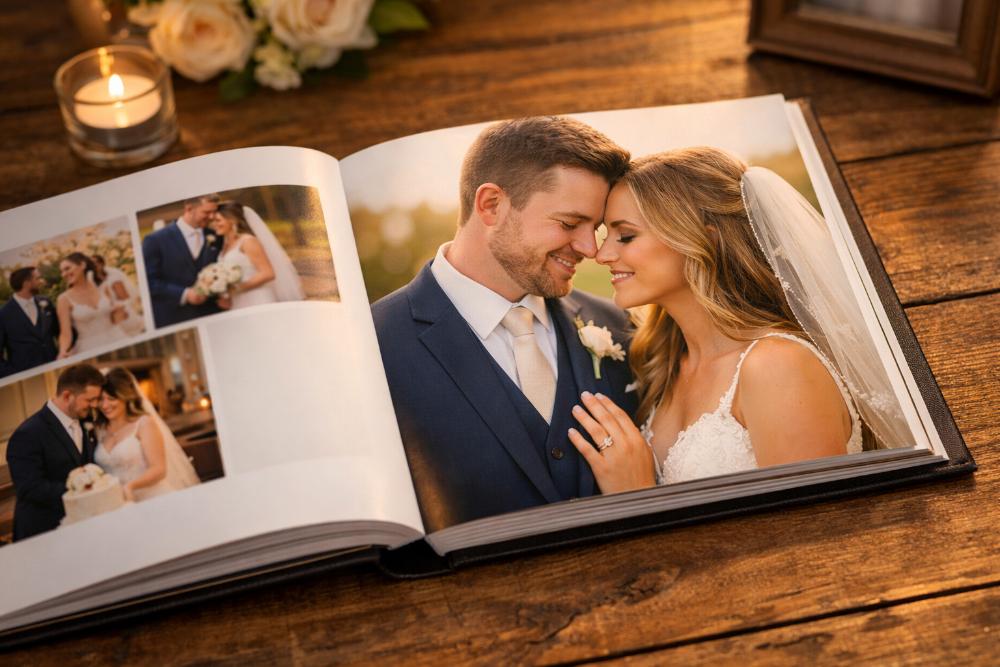
A wedding photo album is still the most popular answer, and for good reason. There’s something genuinely different about holding a physical book of your wedding memories versus scrolling through a digital gallery on your phone. But a photo book is just one option. These days, couples are finding all kinds of creative ways to keep their wedding photos front and center — from gallery walls to canvas prints to magnetic photo tiles you can rearrange whenever you want.
This guide covers the whole picture. We’ll walk you through the best wedding photo album styles and ideas, show you exactly how to build a photo book from scratch, answer the questions couples ask most often, and share some display options your photographer probably didn’t mention.

What Makes a Great Wedding Photo Book?
Not all photo books are created equal. A great wedding photo book tells the story of your day in a way that makes people want to flip through it every year. A mediocre one sits in a drawer and collects dust. Here’s the difference.
Paper and print quality. Thick, lay-flat pages make a huge difference. They stay open without fighting you, and the pages won’t bow or crack over time. Look for a book with high-quality paper stock and accurate color reproduction — you want your photos to look like your photos, not a washed-out approximation.
Cover material. Hardcover books last much longer than softcover. Leather, linen, and faux-leather covers all hold up well over decades of handling. If you want something that feels heirloom-quality, this is worth spending extra on.
Layout and design. A good layout breathes. It doesn’t cram too many photos onto a single spread. It uses full-bleed images for your most dramatic shots and smaller groupings for candids. White space is your friend.
Size. Standard sizes run from 7×7 inches all the way up to 12×12 inches or larger. Bigger isn’t always better — a well-designed 8×8-inch book can be just as impressive as a large-format album. That said, if you have a lot of landscape shots from an outdoor ceremony or a wide reception venue, a larger format lets them breathe.
A clear story. The best wedding albums move chronologically: getting ready, ceremony, cocktail hour, reception, dancing, send-off. This isn’t a rule you have to follow rigidly, but having a narrative arc makes the book far more satisfying to read.
20 Wedding Photo Album Ideas to Inspire You
Before you start designing, it helps to know what style you’re going for. Here are some of the most popular approaches, from the timeless to the totally unexpected.
Classic and Traditional Styles
- Classic leather album — A deep-toned leather cover with gold foil lettering, thick pages, and a layout that leans into your most formal portraits. This is the one your grandchildren will pull off the shelf someday.
- Linen hardcover with pressed florals — Popular with garden and rustic weddings. A linen or fabric cover with a pressed flower or foliage motif gives a soft, organic feel that complements outdoor ceremony photos beautifully.
- Portrait-focused album — Instead of a chronological layout, this style centers on the couple’s portraits throughout, with the rest of the day woven in around them. Great if your portrait session produced some truly standout images.
Modern and Minimalist Styles
- White-page editorial — Inspired by fashion magazines, this style uses bold full-bleed spreads, minimal text, and striking imagery. The clean white pages let the photos do all the talking.
- Black-and-white fine art — An entire book in monochrome sounds like a commitment, but the result is genuinely timeless. Works especially well for documentary-style photography with a lot of emotional candid moments.
- Graphic design-forward layouts — If your wedding had a strong color palette or theme, a designer who leans into it can create a book that’s as much a design piece as it is a photo album.
Warmth and Personality
- Scrapbook-style wedding memory book — This one takes more effort but offers something none of the others can: a mix of photos, handwritten notes, printed vows, pressed flowers, ticket stubs, and other mementos. It’s the closest thing to a tangible time capsule of your wedding day.
- Storytelling captions — Add short captions or quotes throughout your photo book — lines from your vows, the toast your best friend gave, or just a note about how cold it was outside. They make the book feel personal in a way that photos alone can’t.
- "Day in the life" documentary style — Some photographers capture everything from the chaos of getting ready to the last song of the night. If yours did, lean into it. This style resists the urge to only show the "perfect" moments and often produces the most emotionally honest albums.
Unique Concepts
- Guest perspective album — Collect photos taken by your guests — on their phones, or via a photo booth — and create a separate photo book just from their perspective. It’s a completely different view of your wedding that you probably haven’t seen before.
- Details-only album — Flowers, rings, table settings, the cake, the menu cards, your shoes. These often get overlooked in the main album. A small separate book dedicated entirely to the details is a lovely companion piece.
- Engagement and wedding combined — Some couples extend their album to include engagement session photos as an introduction. It adds context and lets the story start before the wedding day itself.
- Parent albums — A slightly smaller version of your main album, designed for each set of parents. It’s one of the most meaningful gifts you can give them, and a tradition worth keeping.
- Elopement album — If you had a small ceremony, that doesn’t mean your photo album needs to be small on feeling. A beautifully designed 20–30 page book with large, expressive images can be more moving than a 100-page traditional album.
Destination and Theme-Driven
- Location-inspired design — For destination weddings, lean into the place. A Tuscan wedding might feature warm ochre tones and hand-lettered maps; a beach ceremony might use a cooler, airy palette. The location becomes part of the design.
- Seasonal palette — Match your album’s colors to your wedding season: crisp whites and silvers for winter, soft blush and sage for spring, warm sunset tones for fall.
Digital-Age Additions
- QR code page — Add a page with a QR code that links to a private online gallery, wedding video, or shared photo album so anyone who picks up the book can access the digital memories too.
- Photo book plus video album — Some couples create a physical photo book alongside a highlight reel on a USB drive tucked into a custom pocket inside the back cover. Old school meets new school.
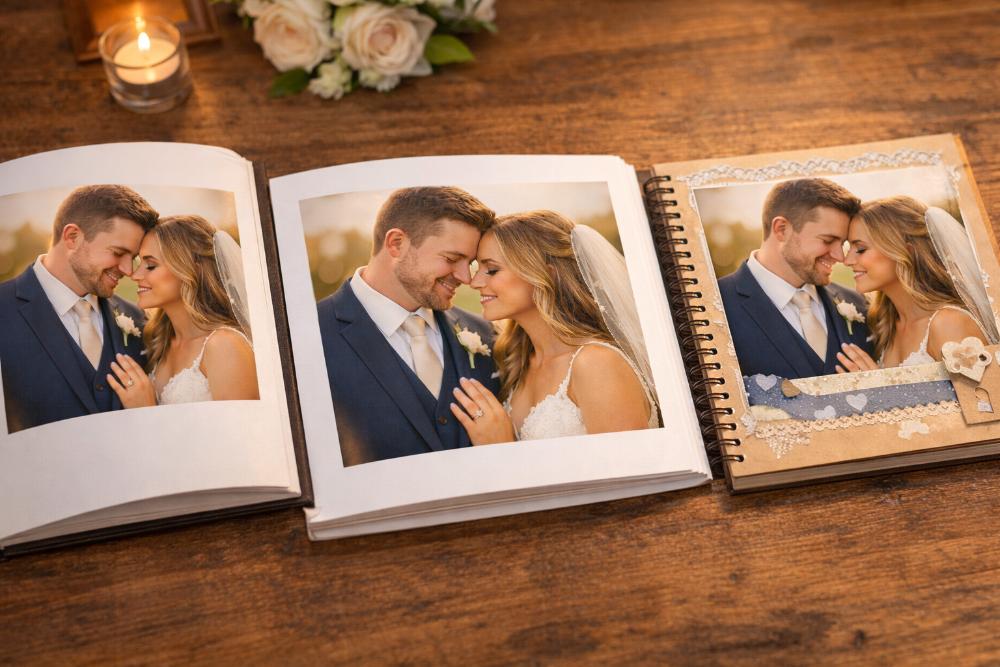
Here’s a quick overview of popular wedding album styles to help you find your fit:
| Album Style | Look & Feel | Best Photo Types |
|---|---|---|
| Classic leather-bound | Timeless, elegant, traditional | Ceremony, portraits, family formals |
| Modern minimalist | Clean white pages, bold images | Detail shots, couples portraits, venue |
| Rustic / boho | Kraft tones, dried florals, warm filters | Outdoor, barn, garden weddings |
| Vintage / retro | Sepia tones, film-style grain, script fonts | Film photography, candid moments |
| Magazine-style editorial | Full-bleed spreads, graphic layouts | Reception, dance floor, fashion-forward |
| Scrapbook / memory book | Handwritten notes, mementos, ephemera | All shots, plus non-photo keepsakes |
| Black-and-white fine art | High-contrast monochrome throughout | Emotional, documentary, intimate moments |
| Destination wedding | Locale-inspired colors and textures | Landscape, travel, getting-ready shots |
How to Create Your Wedding Photo Book Step by Step
Putting together a wedding photo book is a lot more straightforward than most people expect — as long as you give yourself a bit of time and don’t try to include every single photo you received. Here’s a process that works.
- Back up your photos first. Before you do anything else, make sure your wedding photos are saved in at least two places — an external hard drive and a cloud service, for example. Photographers do occasionally have drive failures, and you don’t want to lose these images.
- Gather everything into one folder. If you’re working with photos from multiple sources — your photographer, a second shooter, a photo booth, guests — pull them all into a single folder organized by time of day. This makes the editing and selection process much easier.
- Curate before you design. This is the hardest part for most couples: choosing which photos make the cut. Start by removing any duplicates, closed eyes, blurry shots, or ones where the lighting just didn’t work. Then narrow down to your absolute favorites from each part of the day. Aim for variety — wide shots, close-ups, candid moments, and formal portraits.
- Pick your format and size. Decide early whether you want a square, landscape, or portrait-oriented book, and what size. Square books (8×8 or 10×10 inches) work well for most wedding photography. Landscape (12×9 inches) is great if you have a lot of wide ceremony or venue shots.
- Choose a theme and layout style. Most online photo book services offer templates — some generic, some specifically designed for weddings. Pick one that matches your wedding’s overall aesthetic. If you want more control, start from a blank canvas and design each spread yourself.
- Organize your photos chronologically. A chapter-based structure works well: getting ready → ceremony → cocktail hour → reception → dancing → send-off. This creates a natural narrative flow. You don’t have to label each chapter explicitly — the photos themselves usually make the transitions clear.
- Design your layouts. Use full-bleed spreads for your most dramatic shots — a sweeping venue exterior, your walk down the aisle, your first dance. Group smaller candids together in collage-style layouts. Don’t overcrowd pages. White space makes images feel more intentional.
- Add text sparingly. A date, a name, a short quote from your vows, or a line from a toast can add a lot. But don’t over-caption. Let the photos carry the weight.
- Preview, then order. Almost every online service lets you preview your book as a PDF before ordering. Do this carefully. Check for any photos that look pixelated (watch for anything below 300 DPI at the print size), text that’s too close to the edge, or layouts that looked better on screen than they will on paper.
- Order early, store carefully. Standard printing takes anywhere from a few days to a few weeks depending on the service. Once your book arrives, store it flat, away from direct sunlight and humidity. A cloth storage box or archival sleeve will protect the cover over time.
If you’d like more detail on the technical side of the design process, our guide on If you’d like more detail on the technical side of the design process, our guide on how to make a photo book online walks through the whole thing in plain language, including file format tips and how to get the best print quality from your photos.
How Many Photos Should Go in a Wedding Album?
This comes up constantly, and the honest answer is: it depends on your photographer’s delivery and how detailed you want the album to be. But here’s a practical framework.
- 50–80 photos: A tight, edited album that focuses on the best moments from each part of the day. Works well for elopements, small weddings, or couples who want a clean, modern book.
- 80–120 photos: The sweet spot for most weddings. Enough to cover the full day in detail without feeling padded. A standard 30–40 page book typically holds this range comfortably.
- 120–200 photos: A more comprehensive album that captures everything from details to candids. Best suited to a larger book format (60+ pages) or a layflat album with room for multi-image spreads.
- 200+ photos: Unless your book is very large, this tends to result in tiny images and cluttered layouts. If you have this many favorites, consider splitting them across a main album and a smaller companion album.
A useful rule of thumb: aim for 2–3 photos per page, with occasional full-page spreads for your most impactful shots. More than that and pages start to feel busy; fewer and the book can feel sparse.
When it comes to choosing which photos to include, the most common mistake is trying to tell every story at once. Pick the photos that tell the most important ones.
How Much Does a Wedding Photo Book Cost?
Wedding photo book prices vary more than most people realize — from a few dollars for a basic online book to several hundred for a premium layflat album. Here’s a realistic breakdown.
| Format | Price Range | Best For |
|---|---|---|
| DIY photo book (print-at-home) | $0–$15 | Budget-conscious couples |
| Online photo book (standard) | $15–$60 | Everyday keepsake albums |
| Premium photo book (layflat) | $60–$200 | High-quality coffee table books |
| Luxury photographer's album | $200–$800+ | Heirloom quality, often via your photographer |
| Canvas print (one photo) | $20–$120 | Statement wall piece from a single shot |
| Metal print | $30–$150 | Modern, vibrant display for striking photos |
| MIXPIX® photo tiles (set of 9) | $45–$80 | Gallery wall of multiple wedding moments |
| Forex® photo board | $25–$100 | Large-format, lightweight wall display |
A few things to keep in mind: the price of a luxury photographer’s album often includes the design service, which can take hours of skilled labor. If you’re designing the book yourself through an online service, you’ll save money but spend more time. And if you’re ordering multiple copies — say, a main album plus parent albums — most services offer volume discounts.
For couples who want a beautiful keepsake without the premium price tag, a well-designed online photo book genuinely delivers. The print quality from reputable services is impressive enough that most guests won’t know the difference.
Beyond the Album: Creative Ways to Display Your Wedding Photos
Here’s something most wedding guides miss entirely: a photo book isn’t the only way to keep your wedding memories visible. In fact, for many of your most dramatic photos — the wide ceremony shot, the first dance silhouette, the landscape of your venue at dusk — a photo album might not be the best format at all.
These are the kinds of images that deserve to be on the wall. And the good news is there are more options for doing that than ever before.
Canvas Prints
A large-format canvas print of your favorite wedding photo is still one of the most popular choices for a reason. Gallery-wrapped canvas has a warmth and texture that works in almost any room, whether it’s hanging above a fireplace or in a bedroom.
The images that tend to work best on canvas are ones with strong composition, bold colors, or emotional weight: your ceremony kiss, a wide shot of your venue, or a couples portrait with beautiful light. Highly detailed close-ups — macro shots of rings, flowers, or table settings — can lose some of their fine detail on canvas.
If you want to explore the options, we’ve got a full guide on wedding canvas print ideas covering sizes, finishes, and how to pick the right image. Canvas prints from Canvas Discount start at very competitive prices with professional-quality HP latex printing.
MIXPIX® Photo Tiles
If you’re not ready to commit to a single large print, MIXPIX® photo tiles are worth knowing about. These are small, square photo prints mounted on a lightfoam core that attach to walls using Magnofix® — a magnetic and adhesive hanging system that doesn’t require drilling.
The appeal is flexibility. You can start with three or four tiles and add more over time. You can rearrange them whenever you want. And because there’s no drilling required, they’re ideal for renters or anyone who doesn’t want to commit to a permanent installation.
A set of nine MIXPIX® tiles arranged in a grid or organic cluster is a really effective way to display a range of moments from your wedding — portraits, details, venue shots, candids. It’s the closest thing to a physical Instagram wall.
Metal Prints
Metal prints are printed directly onto aluminum composite panels, which gives them a vivid, high-contrast look that’s unlike any other format. Colors are more saturated, darks are deeper, and the slight sheen of the aluminum shows through in lighter areas of the image.
They work especially well for photos with strong graphic elements: bold wedding florals, architectural venue shots, dramatic lighting. They’re also extremely durable — scratch-resistant, moisture-resistant, and significantly longer-lasting than paper prints. For a modern home with clean lines, a large metal print of a wedding photo can be a genuinely striking design feature.
Forex® Photo Boards
Forex® photo boards are a lightweight large-format option that’s especially useful for display at the reception itself — a welcome sign, an engagement photo display, or a seating chart with photos. Post-wedding, they make a great large-format wall piece in a home office or hallway.
Forex® is made from hardfoam (technically foamed PVC), so it’s much lighter than a framed print of the same size. That makes it easy to hang and to move if needed.
Building a Wedding Gallery Wall
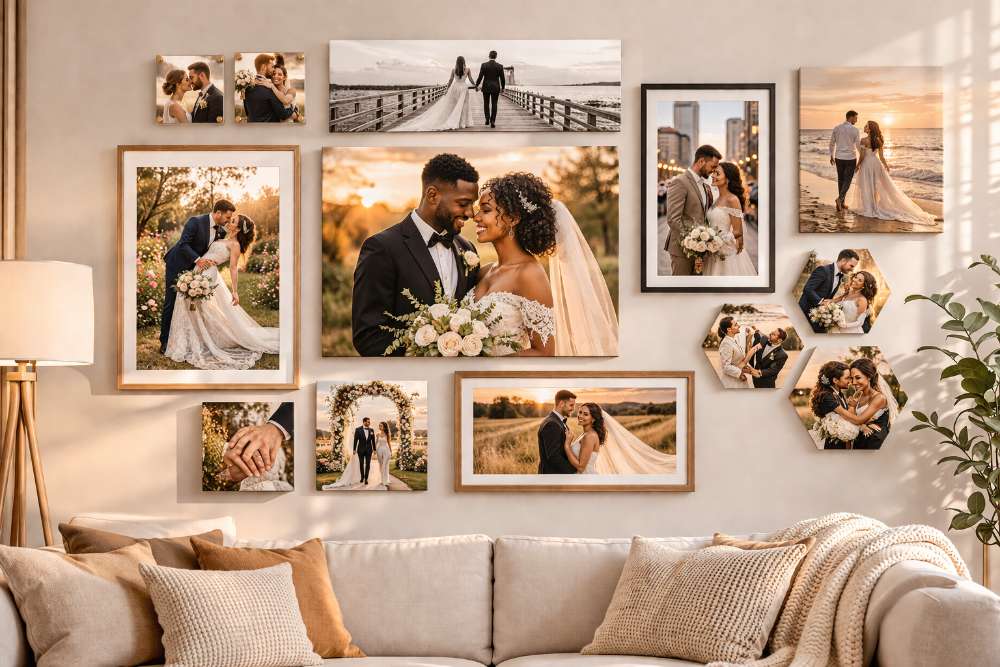
One approach that’s become genuinely popular over the last few years is combining formats into a gallery wall. A large canvas print as the anchor, surrounded by a few MIXPIX® tiles and a couple of metal prints, creates a display that has visual depth and tells a more complex story than any single format could.
Wedding Photo Gifts Your Family Will Treasure
One of the most meaningful things you can do with your wedding photos is share them. A parent album, a canvas print for a sibling, or a set of photo tiles for a close friend means more to most people than almost any gift you could buy.
Parent Albums
If your parents paid for any part of the wedding, a photo album of their own is the least you can do. And even if they didn’t, it’s a genuinely lovely gesture. A smaller version of your main album — say, 20–30 pages with a curated selection of family moments — is something most parents will display proudly and return to again and again.
Some couples create slightly different parent albums for each family, emphasizing photos of that family alongside the general wedding highlights.
Canvas Prints as Gifts
A wedding canvas print is a thoughtful gift for parents, grandparents, or close siblings who weren’t in the wedding party but played a big role in your lives. A medium-format canvas of a family group portrait, or of the couple’s first dance, tends to resonate more deeply than a framed print because of its warmth and visual presence.
Photo Tiles for Friends
A set of MIXPIX® photo tiles featuring a mix of photos with you and a close friend — from the wedding and from years of friendship before it — is an unexpectedly personal gift. It’s also one that’s easy to customize at the last minute without losing quality.
Anniversary Keepsakes
Your wedding photos don’t have to live only in the past. Plenty of couples revisit them for anniversary gifts — a new canvas print each year, a metal print to mark a milestone, or a second photo book that tells the story of your first years of marriage alongside the wedding.
If you’re thinking ahead, our guide on wedding anniversary gifts by year has ideas for every anniversary from the first to the fiftieth, many of which tie naturally back to your photos.
How to Choose the Right Format for Each Photo
Not every wedding photo suits every format. Here’s a quick guide to matching your images to the right product.
- Album or photo book: Works for all photo types. Best for building a narrative, grouping candids, and including photos with emotional context that benefits from sequencing.
- Large canvas print: Best for wide-angle ceremony shots, dramatic first dance images, sweeping venue exteriors, and couple portraits with beautiful natural light. Less suited to close-up detail shots.
- Metal print: Best for photos with vivid colors, strong graphic composition, or dramatic contrast — florals, twilight portraits, architectural venue shots.
- MIXPIX® photo tiles: Great for square-cropped portraits, candid moments, and creating a diverse multi-photo display. Works at smaller sizes, so simpler compositions do best.
- Forex® photo board: Best for large-format display where you need something lightweight. Works well for single strong images — a wide couple portrait or venue exterior — in a hallway or home office.
- Photo book (additional copy for gifts): Ideal for family portraits, group shots, and any images that include the recipient. Personal selections make parent albums especially meaningful.
Final Thoughts
Your wedding photos deserve better than a folder on a hard drive that nobody opens. Whether you create a carefully designed photo book, hang a canvas print above your fireplace, or build a gallery wall that grows with you over the years, the goal is the same: to keep those memories visible and part of your everyday life.
The format you choose matters less than the decision to do something. Start with the photos you love most. Build from there.
Frequently Asked Questions About Wedding Photo Albums
-
Most wedding albums contain between 80 and 120 photos, which is enough to cover the full day — getting ready, ceremony, portraits, reception — without padding. A tighter edit of 50–80 photos can produce a cleaner, more elegant book. If you have a very large collection and want to include more, consider a second companion album rather than cramming everything into one.
-
Prices range from around $15–60 for a standard online photo book to $200–800+ for a luxury photographer’s album with premium materials and design services. Most couples creating a keepsake album themselves through an online service spend $50–$150 for a high-quality hardcover book with lay-flat pages.
-
A photo book is printed like a book — photos are printed directly onto the pages. A traditional photo album holds printed photos in sleeves, pockets, or with corner mounts. Photo books are more popular today because they’re easier to design, more affordable to produce, and tend to look more polished. Traditional albums with physical prints have a tactile, archival quality that some couples prefer.
-
Start by removing any technically poor shots — blurry, poorly exposed, or redundant images. Then pick your absolute favorites from each section of the day: getting ready, ceremony, portraits, reception. Aim for a mix of wide shots, close-ups, and candid moments. A good rule of thumb: if you’re hesitating about a photo, it probably doesn’t make the cut.
-
Yes — and many couples do. You can design a photo book entirely online using your own photos and a template, then have it professionally printed. The result is often indistinguishable from a more expensive album. The trade-off is time: a well-designed album can take anywhere from a few hours to a full weekend, depending on how many photos you’re working with.
-
Square formats (8×8 or 10×10 inches) work for most wedding photography. Landscape formats (12×9 or larger) suit weddings with lots of wide shots from outdoor ceremonies or scenic venues. Portrait formats (8×10 or 8.5×11 inches) are good if many of your best photos are vertically framed. When in doubt, go with a 10×10 or 10×8 landscape — they’re the most versatile.
-
Canvas prints, metal prints, MIXPIX® photo tiles, and Forex® photo boards all offer ways to display wedding photos permanently in your home. Many couples create a photo book for the narrative keepsake and use one or more wall-mounted formats for the photos that work best at large scale. A gallery wall combining multiple formats is increasingly popular.
-
Canvas prints made with HP latex inks — as we use at Canvas Discount — are rated to last 75+ years without fading when kept out of direct sunlight. Metal prints are also extremely durable, with no paper to degrade or crack. Both will outlast most photo books with proper care.
-
Chronologically works best for most couples: getting ready → ceremony → portraits → cocktail hour → reception → dancing → send-off. You can vary the structure — some couples open with a dramatic full-page image before going back to the beginning — but a clear narrative arc makes the album far more satisfying to read.
-
Several online services offer wedding photo books, including Canvas Discount, which offers professionally printed photo books with a wide range of wedding-themed templates and lay-flat binding options. You design the book yourself using our online tool and we handle the printing and delivery.