World Cup Group Photo Ideas: 15 Poses for Large Fan Crews (US 2026 Playbook)
 by Ashley Carter
 8 Minutes
You've got fifteen friends crammed into a sports bar booth, the USA match kicks off in five minutes, the lighting is dim, somebody just walked off to grab another round, and somebody else just yelled “group photo!” What you usually end up with: half the crew blinking, three people half-out of frame, a row of phone screens in everyone's hands, and your buddy's chin doing something nobody wants to remember.
And six months later, when you want to look back at the summer the US co-hosted the World Cup, that's the photo. Just one. And it's rough.
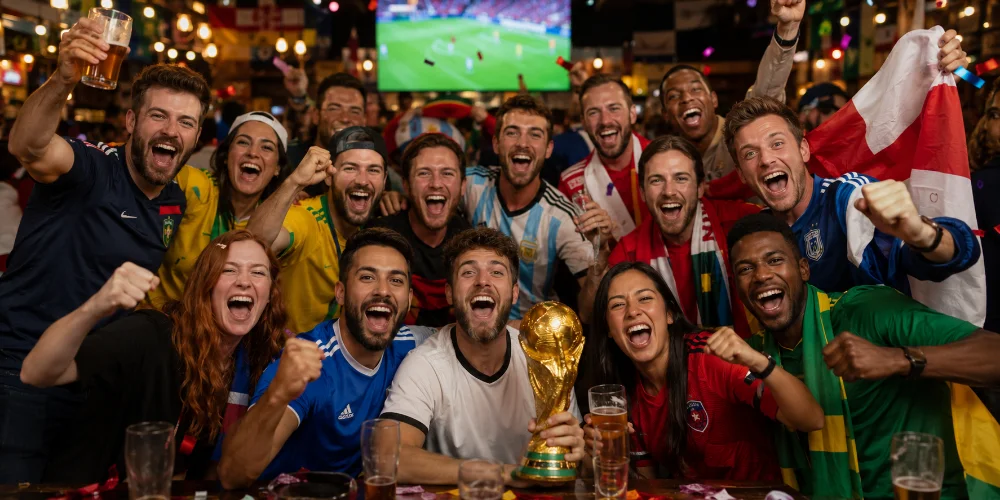
This playbook fixes that. We've broken down 15 group photo formations sorted by crew size, five lighting nightmares with the fix for each, seven tricks for natural smiles, a 3-minute match-day plan, and venue-specific advice for the five places American fans actually watch the games — sports bars, home watch parties, FIFA Fan Festivals, stadium concourses, and backyard cookouts. Everything is built around what phone cameras can actually do, not what a pro photographer's $5,000 rig can.
The 2026 World Cup runs from June 11 to July 19, with 48 teams, 104 matches, and 16 host cities across the US, Mexico, and Canada. The final is at MetLife Stadium in East Rutherford, New Jersey. American fans haven't had a World Cup on home soil since 1994. There will be more group-photo moments than at any tournament in history. Let's make sure at least a couple of them are worth printing.
| At a glance | Pick a formation that matches your crew size (4–7, 8–14, 15–24, or 25+). Set your phone to wide-angle 0.5x and turn on grid lines. Take 8–10 shots in burst mode, not one. Get the group to shout a word together on “three” for natural smiles. Move toward window light, away from overhead spotlights. Take both posed and candid versions. Print the best shot before the photo lives forever on a phone you'll lose in three years. |
|---|
Why World Cup group photos are different from the average snapshot
Regular group photos get taken, dropped in a group chat, scrolled past, and forgotten. World Cup ones aren't like that.
They mark a time and a crew. The summer the US went deeper than anyone expected. The bar where you watched your team's group-stage finale. The friends who happened to be in your life when something big was happening on the screen. The kids in oversized jerseys who'll be teenagers by the next World Cup.
Those photos earn their place on a wall, a fridge, a mug, a coffee table book. A six-week tournament gives you more shots at a brilliant photo than almost any other event — you just need to be a little intentional about how you take them, and a lot more intentional about what you do with the best one when the tournament is over.

15 group photo formations sorted by crew size
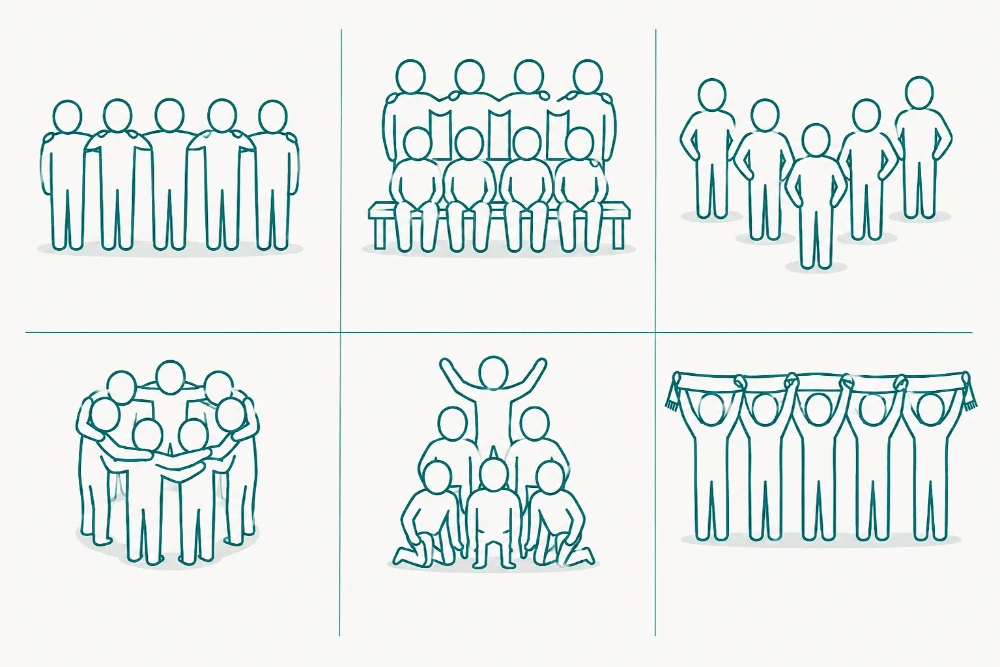
Generic “stand in a line and smile” advice falls apart the second your crew gets past about eight people. These 15 formations are sorted by crew size, so you can jump straight to the one that fits the group in front of you. Every formation includes a sentence on how to nail it and where it works best.
For small crews (4–7 people)
1. The shoulder-lock line
The simplest formation that actually looks good. Everyone stands shoulder-to-shoulder in a single horizontal row, tallest person in the middle, shortest at the edges. The line picks up a gentle downward curve toward the ends, which reads more natural than a flat schoolroom row.
How to nail it: lock shoulders so there are two to three inches of overlap between each person — tighter than feels comfortable. The people at each end angle their bodies slightly inward, like they're closing a hug.
Best for: pre-match outside the bar, against a plain wall, in front of the front door.
2. The pyramid huddle
Two or three people on one knee at the front, the rest stacking into a small pyramid behind them. The tallest person hits the apex at the back center. Compact, energetic, slightly chaotic in a way that reads as personality.
How to nail it: front-row kneelers should sit back on their heels, not straight up on their knees. The middle row leans slightly inward; the apex tilts forward. The whole shape should feel like it's leaning into the camera.
Best for: backyard cookouts, post-match yard celebrations, smaller groups that want energy over formality.
3. The V-stagger
A shallow V opens toward the camera. Two people at the back point of the V, three or four fanning out to the front. The depth makes the photo look like a magazine spread, not a class portrait.
How to nail it: the people at the front of the V sit lower than the back — crouching, sitting on a wall, or naturally shorter. Keep the angles loose; too sharp a V looks like a marching band.
Best for: medium-small crews in beer gardens, parks, fan zones, parking lots.
4. The booth tilt
Everyone in a booth or banquette, half turning inward as if mid-conversation, half facing the camera. Drinks raised or hands flat on the table, no phones visible. Looks editorial, social, lived-in.
How to nail it: lean the booth occupants slightly toward the photographer rather than facing dead-on. Hands and drinks on the table; elbows tucked. Phones away.
Best for: sports bar booths, restaurant tables, post-match dinners.
For mid-size crews (8–14 people)
5. The two-row tier
Half the crew seated on a bench, couch, or low wall in front. The other half standing directly behind, with their faces visible in the gaps between the seated heads. The workhorse formation for mid-size groups.
How to nail it: each standing person's face should appear between (not directly behind) two seated heads. Front row leans slightly forward; back row packs in tight. Back row can stand on tiptoe if there's a height mismatch.
Best for: living-room couches, restaurant booths, the bench seats outside most American sports bars.
6. The half-circle
An open arc facing the camera, with the photographer at the focal point of the curve. People at the back angle their bodies inward, like a stadium photo of a team huddle from above. Reads as inclusive and connected.
How to nail it: keep the arc shallow — too wide and the ends fall out of focus. Tallest people in the back of the curve, shorter at the ends. Everyone angles their feet toward the photographer.
Best for: post-goal celebrations, large living rooms, fan zones with room to spread out.
7. The scarf or flag arms-up
Everyone in a single line or shallow arc, holding a stretched-out scarf or flag above their heads with arms raised. The signature soccer-fan formation — it photographs particularly well in matching jerseys.
How to nail it: pick the longest scarf or flag you can find, or string two together. The whole crew leans slightly back so faces remain visible under the raised arms. Tallest people in the middle keeps the scarf at an even height. Have everyone cheer mid-shot.
Best for: outside the stadium, fan zones, big celebration moments, tailgates.
8. The bench-and-back
Long bench or counter at the front with five to seven people seated along it, three to five more standing in a relaxed grouping behind. Less formal than the two-row tier, more curated than a candid.
How to nail it: seated row keeps drinks at chest height, hands relaxed. Standing row staggers slightly — not a stiff line behind, but a loose cluster. One or two people in the back can hold up a flag or scarf for visual interest.
Best for: kitchen islands during home watch parties, outdoor picnic tables, sports bar counters when the bar isn't busy.
For large crews (15–24 people)
9. The squad-photo tier
Three rows. Front row kneeling or crouching. Middle row seated on chairs. Back row standing. This is the formation team photographers use for actual soccer squad shots, and it's brilliant for fan crews because it visually echoes a team lineup.
How to nail it: stagger the rows so faces aren't directly stacked on top of each other. Kneeling row leans slightly outward (not forward, which puts heads in the way of the seated row). Chair row sits with straight backs and shoulders rolled back.
Best for: end-of-tournament group portraits, family gatherings around the screen, formal-ish photos that want to look intentional in ten years.
10. The flag-stretcher line
Twelve to twenty people in a single elongated row, all holding a giant flag stretched horizontally across their faces or above their heads. Reads as a statement piece, especially with an American flag, a country flag for the team you're following, or a custom team banner.
How to nail it: the flag should be long enough that the people at the ends still have a comfortable grip. Two people at each end hold the flag taut; everyone else just steadies it. Faces tilt up so they're visible above (or below) the flag.
Best for: fan zones, stadium concourses, large outdoor settings.
11. The huddle around a prop
Everyone gathers around a focal point — a flag, a trophy replica, a printed bracket, a custom jersey laid out on a table. The crew leans in toward the prop from all sides. Photographer shoots from slightly above.
How to nail it: the prop should be small enough that everyone can lean over it without blocking each other. Faces angle up, not just toward the prop. Photographer steps onto a chair or a step stool to get the elevated angle.
Best for: draft-day-style fantasy watch parties, bracket-prediction nights, anywhere there's a centerpiece worth showing off.
12. The wedge formation
A tight wedge or arrowhead pointing at the camera. One person at the front point, two behind, then four, then the rest fanning out at the back. Compact, dramatic, slightly hero-shot in feel.
How to nail it: the front-point person should be sitting or kneeling so they don't block the second row. Each row behind packs in tight — shoulder-to-shoulder. The back row can spread wider to fill the frame.
Best for: intro-shot group portraits with a recognizable backdrop — a stadium, a fan zone screen, a famous city skyline.
For mega crews (25+ people)
13. The stadium step-back
The photographer steps back 25 to 35 feet, climbs onto a chair, step, table edge, or low wall, and shoots wide. The crew arranges into three or four rough tiers. The background — the stadium, the fan zone screen, the bar frontage — fills out the frame around them.
How to nail it: you absolutely need the 0.5x wide-angle lens. The photographer's height matters: shooting from eye level with the crew creates depth problems. Get up high. Pick a background that earns its place in the frame.
Best for: fan-zone meetups, stadium concourses, big house watch parties spilling into the yard.
14. The aerial overhead
Photographer shoots from above — a balcony, an upper level of a bar, the second floor of a house, even a staircase landing. The crew arranges in a loose cluster below, faces tilted up. The geometry of bodies from above is what makes it work.
How to nail it: everyone needs to tilt heads fully up, not just glance up. Otherwise you photograph the tops of heads, which is nobody's best angle. The photographer leans out slightly to avoid foreshortening the people directly underneath them.
Best for: two-story houses, sports bars with mezzanines, stadium upper-deck steps before the crowd thickens.
15. The crowd-and-frontline
The front line of your crew (15 to 20 people) stages a formal pose; the rest of the crowd is arranged loosely behind them, half in focus, half blurred. The result reads as a fan-army photo — you can see your specific friends but the scale of the crowd around them is the story.
How to nail it: front line stands shoulder-to-shoulder in a tight squad-photo tier. Crowd behind doesn't pose — they're just there. Photographer keeps focus on the front line; depth-of-field does the rest. Best in a fan zone where the crowd has natural energy.
Best for: FIFA Fan Festivals, viewing parties at venues with hundreds of fans, the largest end-of-tournament gatherings.
Phone camera setup in 60 seconds (iPhone + Samsung)
Most group photos get ruined by default phone settings. Sixty seconds of setup before the match starts fixes about 80% of common problems.
Universal settings (works on any phone)
- Turn on grid lines. Settings → Camera → Grid. Helps you center the crew rather than chopping someone's head off.
- Use the 0.5x wide-angle lens for crews over six people. The 1x lens makes you back up too far; the telephoto (2x, 3x) loses light and looks worse.
- Skip Portrait mode for groups bigger than six. It gets confused about depth and starts blurring out the people on the edges.
- Skip Night Mode unless you're outside and it's actually dark. Indoors it produces longer exposures, which means anyone who moves comes out blurred.
- Use burst mode for every shot. Hold down the shutter to take 8 to 15 frames in succession. The brilliant one is in there somewhere.
iPhone specifics (any model from iPhone 12 onward)
Open Camera. Tap the upward arrow at the top of the screen to reveal the toolbar. Tap the timer icon, choose 10 seconds. Tap the 0.5x lens button. Tap the HDR icon and switch it off if anyone in your group is going to move during the shot.
Samsung Galaxy specifics (S22 and newer)
Open Camera. Tap the gear icon for settings. Find Shooting Methods → Timer → set to 10 seconds. Tap the wide-angle 0.5x icon on the screen. In Settings, turn off Scene Optimizer if your group photos consistently come out with weird color casts.
Pixel and other Android specifics
Most Pixel and Android phones from the last three years have similar setups: 10-second timer in the toolbar, wide-angle lens icon on the main shooting screen, and burst mode by holding down the shutter. If you're not sure, search “group photo settings [your phone model]” once before the tournament and you'll have it locked in for six weeks.
5 fan-photo lighting nightmares (and the fix for each)
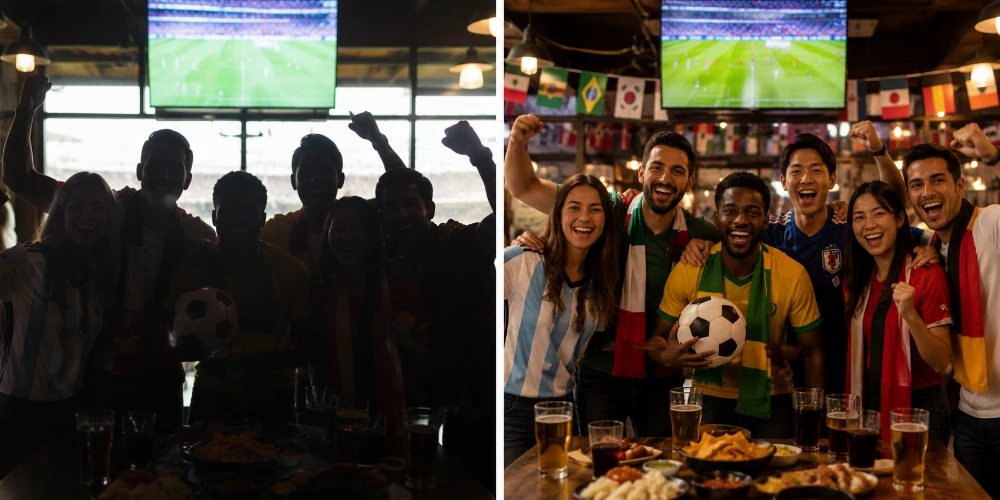
Lighting is the single biggest reason World Cup group photos disappoint. Sports bars are dim. Living rooms have a bright TV overpowering the room. Stadiums are floodlit with brutal contrast. Here are the five most common situations and how to fix each one in under a minute.
Nightmare 1 — the dim sports bar interior
Warm yellow bulbs. Low ceiling. Everything indoors looks slightly orange and slightly blurry.
- Move the crew toward the front window or open door. Daylight, even on a cloudy day, is brighter and cooler than tungsten bar lighting.
- Avoid backlighting at all costs. Window directly behind the group equals silhouettes. Window to one side equals beautiful soft light.
- Turn off Night Mode. It causes longer exposures and motion blur on anyone who moves.
- Have one person hold a phone flashlight pointed up at the ceiling above the crew — not at faces — as a soft fill light.
Nightmare 2 — the TV-lit home watch party
Big TV showing the match. Everyone facing the screen. The TV is the brightest thing in the room, throwing weird blue light onto half the crew.
- Pause the match at halftime and switch on all the room lights. The TV stops being the dominant light source.
- For an atmospheric TV-on shot, position the crew between the TV and the camera. The screen becomes a soft background glow instead of the main light.
- Skip the single overhead recessed light. Down-lighting from one source creates harsh shadows under eyes and chins.
- Drape a couple of personalized photo blankets over the back of the couch for color and texture in the frame. They warm up cold living-room lighting and read in the photo as a watch party rather than just a living room.
Nightmare 3 — stadium floodlights
If you've made it to a 2026 World Cup match in person, congrats — those tickets weren't cheap. Floodlights are powerful, but the contrast is brutal: bright on the tops of heads, dark under noses and chins.
- Tilt the crew's faces slightly upward so the floodlight reaches under brows and down to chins.
- Group photos work better in the concourse before kickoff than in the seats during the match — more even lighting, less crowded background.
- Post-match shots on the way out, with the lit stadium behind the crew, look brilliant if your phone has a Night Mode that can handle the contrast.
Nightmare 4 — harsh outdoor sun (tailgate, beer garden, backyard)
Bright midday sun. Everyone is squinting. Harsh shadows under noses. Foreheads white-hot.
- Move the crew into open shade — under an umbrella, against the side of the building, into a tree's shadow.
- If you can't avoid direct sun, position the group with the sun behind the camera, but not directly overhead. Mid-morning or late-afternoon sun is the most flattering.
- Get everyone to close their eyes for three seconds, then open them on “now.” Kills the squinting epidemic instantly.
Nightmare 5 — mixed lighting (the worst kind)
Window on one side, overhead spotlight on the other, TV glow in the corner. Every person is lit differently. One side of the crew looks blue, the other looks orange.
- Pick one light source and let it dominate. Either pull the group toward the window and switch off the overhead, or move them fully into indoor light.
- Phone cameras can correct mixed lighting reasonably well in editing. The free Snapseed app has a White Balance slider that fixes most of it after the fact.
- If all else fails, convert to black and white. Mixed-temperature lighting that looks weird in color often looks brilliant in monochrome.
Posed vs candid: when to flip between modes
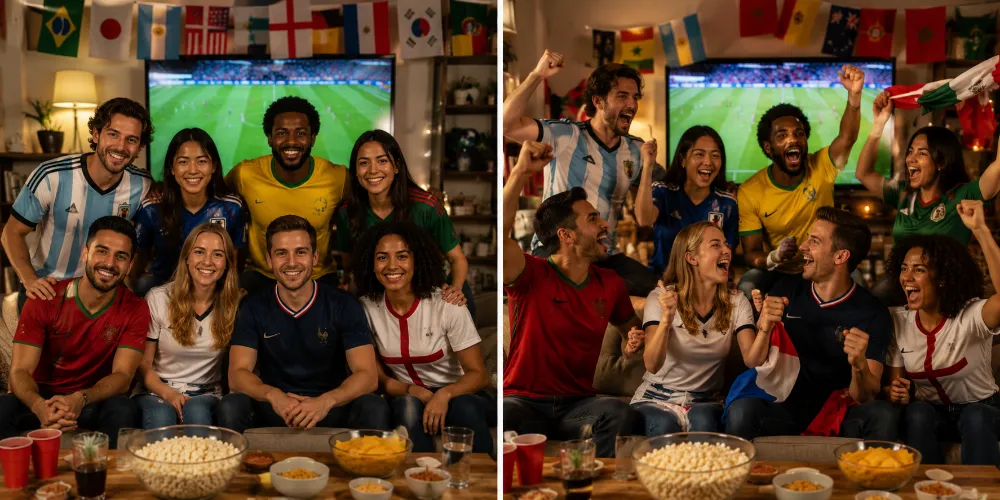
The single biggest mistake in fan group photos is committing to only one mode. Posed shots are the ones that end up on the photo book cover. Candid bursts are the ones that capture how the tournament actually felt. The best collections include both, in roughly a 60/40 ratio.
Go posed when...
- The crew is calm and focused — before kickoff, during halftime, right after the final whistle but before the chaos.
- You want the photo to look intentional in five years' time.
- You're running a year-on-year tradition (same crew, same formation, same bar, every World Cup or every Super Bowl Sunday).
- Someone in the group is wearing a jersey they'll never own again, sporting a haircut they'll later regret, or showing off a baby bump.
Go candid when...
- Something just happened on the screen and people are reacting. Never interrupt a celebration to ask for a pose.
- The crew has reached the point in the evening where posed shots aren't realistic anymore.
- You want the photo for personal memory rather than wall display.
- You can fire burst mode and pick the best frame later.
The 5-photo World Cup set
If you want to be slightly methodical about it, here is the set that produces the most material at the end of the tournament:
- One posed group portrait at the start of the tournament, in match-day jerseys, taken in good light.
- One candid celebration from the most exciting moment of the group stage.
- One posed group photo before a knockout-round match — same crew, same formation, jerseys back on for continuity.
- One candid celebration from a knockout goal or final-whistle moment.
- One posed end-of-tournament group photo, ideally in the same formation as photo #1.
Three posed, two candid. Same crew through the whole tournament. The arc of the tournament is visible in the mood progression — hopeful at the start, joyful or heartbroken at the end. That's a complete six-week story in five frames.
7 tricks for natural smiles (every single time)
Posed photos die on the row of polite clenched-teeth smiles. These seven tricks fix it.
1. The shouting trick
Just before pressing the shutter, get the crew to shout one word together — “goal!”, “USA!”, “three!”, the name of the team you're watching. The shout opens mouths into natural smiles, gets energy up, and stops the row of polite grimaces.
2. The countdown + delay
Tell the crew you're counting “3, 2, 1, click” — then deliberately wait two beats after “click” before actually firing the shutter. Most people's posed smile fades by the second beat; the natural laugh-out-loud reaction kicks in. Fire then.
3. The unrelated question
Ask the group a random question right before the shutter — “who's bringing the chips for the next match?”, “who lost the bracket last round?”. The reaction shots are gold.
4. The eyes-closed reset
“Eyes closed for three seconds. On 'now,' eyes open and smile.” Eliminates blinking, opens eyes wider than usual, and resets every face mid-pose. Works on 90% of crews on the first try.
5. The burst-mode safety net
Don't take one shot. Take 8 to 15 in burst mode by holding down the shutter. In a group of 10, statistically there's a 50% chance someone blinks in any single frame. With 10 burst frames, you can almost always find one where everyone's eyes are open.
6. The post-shutter chatter
After the official posed shot, keep the phone up and keep shooting while the crew breaks formation, laughs, talks to each other. The unposed second-wave shots are often better than the posed one.
7. The morning-after mug
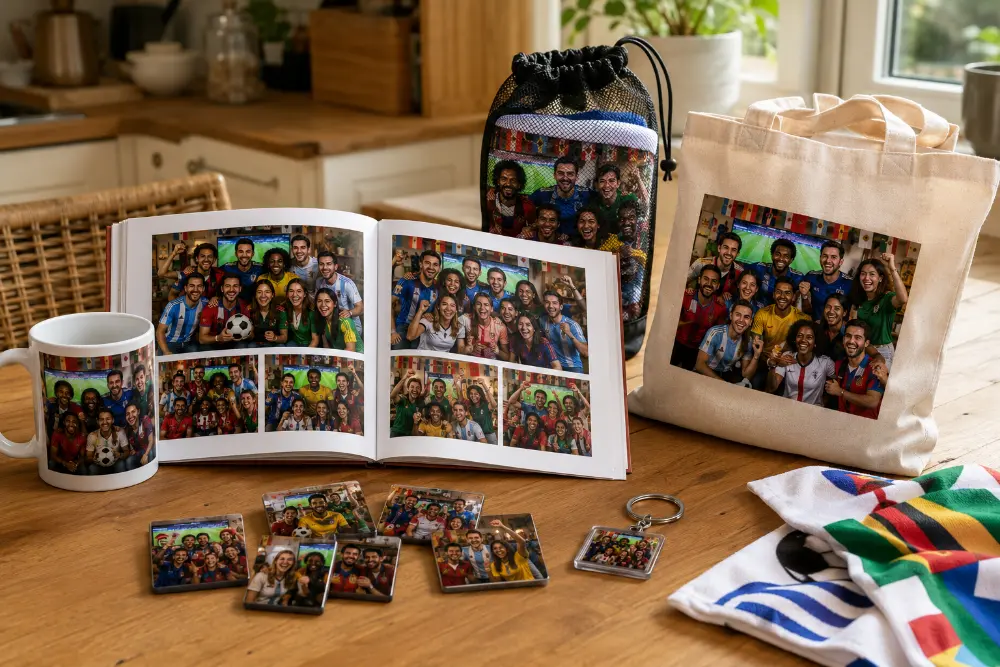
This one's a long game, but it works. Pick the single best shot from the day's group photo, get it printed on a custom photo mug before the next match, and give them out to the crew. People take photos with the mug in the next watch party — you'll get a chain of group photos that all reference each other across the tournament. The mug becomes part of the running joke. And whichever friend insisted on iced coffee in February gets the heat-sensitive magic mug version, where the photo only appears once a hot drink is poured in.
The awkward-people playbook
Every crew has them. The friend who hates being photographed. The kid who can't keep still. The tall guy who blocks four people if you put him in the wrong row. Here's how to handle each one without it derailing the shoot.
The tall friend
Back row, center. Always. Putting a 6'5" friend in the front row of a squad-photo tier wastes the formation entirely — they block everyone behind them. In a single-line shoulder lock, they go in the middle. In a V-formation, they go at the apex.
The serial blinker
Burst mode is your friend (see trick #5). For a single-shot scenario, use the eyes-closed reset (trick #4). If neither works, position them slightly behind another person so a closed eye in the final shot is less visible.
The kid who won't stand still
Kids are great in fan group photos because their energy is genuine. The trick is to position them where they can move a little without breaking the frame — front-row corner, on a parent's lap if seated, or holding a flag or scarf they can fidget with. Don't try to lock them in a formal pose; the slightly-blurry kid makes the photo feel alive.
The camera-shy friend
Don't put them at the center of the frame. Edge of the line, slightly behind another person, half-obscured by a flag prop. They get to be in the photo without being the focus. Most camera-shy friends would rather be there than skip the photo entirely — they just don't want to be the centerpiece.
The friend who keeps checking their phone
Hand them a prop. A scarf to hold up, the bracket to point at, a beer to raise. Anything to give their hands a job that isn't the phone. Works 100% of the time.
5 American fan settings, decoded
Where you shoot matters as much as how you pose. Here's the specific playbook for the five places American World Cup fans actually gather.
1. The neighborhood sports bar
- Best spot: near the front window if there is one, ideally with the front door propped open for daylight.
- Backup spot: against a feature wall — exposed brick, dark wood paneling, anywhere with character.
- Avoid: the front of the bar (busy background), directly under a TV (harsh down-lighting), the booths facing the kitchen pass.
- Time it: halftime, full time, or right before kickoff. Never during a goal celebration mid-match.
- Bar etiquette: ask the bartender quickly before you set up. Most are happy to help during a quieter moment. Don't block walkways.
2. The home watch party
- Best spot: standing in front of the couch with the TV behind the camera so the screen doesn't dominate.
- Backup: a seated formation on the couch, photographer crouched in front.
- Light: pause at halftime, switch on all the side lamps and the overhead, take the shot, then resume the match.
- Avoid: the kitchen island (too busy), and any wall covered in unrelated family photos (visually chaotic).
- Bonus: once you've got a few great match-day group photos, swap them onto the fridge as a rotating gallery with MIXPIX® photo tiles. The magnetic + adhesive Magnofix® hanging system means one tile per match across the tournament, all stuck up next to each other on the fridge — zero drill holes, no damage when you move out, and you can swap tiles around as new matches happen. Cheaper than a couple of rounds at the bar for the whole set.
3. The FIFA Fan Festival
FIFA Fan Festivals will run in cities across the host nations during the tournament — giant screens, food vendors, live entertainment. Confirmed US locations include Liberty State Park in Jersey City, Fairmount Park in Philadelphia, and East Downtown Houston.
- Best spot: a recognizable feature — the giant screen in the background, an entry archway, the official tournament branding.
- Best time: 30 to 45 minutes before kickoff for daytime games, early afternoon for evening matches. Before the crowd peaks.
- Practical tip: fan zones get loud. The shouting trick (trick #1) earns its keep here.
- Wide shots of the fan zone with your crew in the foreground often make better keepsakes than tightly framed group portraits. The scale of the crowd is part of the story.
4. The stadium concourse
If you've made it to a 2026 World Cup match in person, the concourse is your group-photo gold.
- Best spot: 30 to 45 minutes before kickoff. Lighting is even, the background is recognizable (concrete walls, signage, exit gates), and the crowd hasn't peaked.
- Avoid: the seats during the match. Too dark, too cramped, and you risk blocking the view of people behind you.
- Post-match shots on the way out, with the lit stadium behind the crew, work brilliantly if your phone has a strong Night Mode.
5. The backyard tailgate or cookout
The tailgate is an American institution and it transfers beautifully to World Cup season. There's no rule that says you can only tailgate in an NFL parking lot.
- Best spot: behind a long picnic table loaded with food, with grill smoke softening the background slightly.
- Best time: late afternoon, sun behind the camera. Golden hour is the photographer's best friend.
- Bring: jerseys, scarves, a flag for the backdrop, and a long table that suits the bench-and-back formation.
- For matches that fall during the day — and there are plenty in the group stage — a backyard with the game on a portable screen or projector is one of the best photo settings on this list. Open space, good light, twice as many people as you can squeeze into a living room.
The 3-minute match-day photo plan
Before kickoff (60 seconds)
- Scout your spot. Pick the location with the best light and simplest background. Tell the crew where you'll meet them at halftime.
- Open the camera app, switch to 0.5x wide-angle, turn on grid lines, set the timer to 10 seconds, fire one test shot.
- Pick your photographer and your spotter (if the crew is over 15).
At halftime or the natural break (90 seconds)
- Walk the crew to the spot. Tell them the formation in one sentence.
- Position the tallest people first, build outward. Aim for the right formation for your crew size from the 15-pose list above.
- Take 8 to 15 burst shots. Use the shouting trick (trick #1) on the third or fourth shot.
- Take 3 to 5 more shots after the official pose breaks — the unposed second wave is often the best one.
Mid-match (30 seconds, only when triggered)
- During any big moment on the screen — goal, near-miss, save — fire burst mode while watching faces, not the screen.
- Take 10 to 15 frames. Sort through them later.
After the final whistle (during the celebration or commiseration)
- Capture the immediate reaction in burst mode.
- When the crew has settled, take one final posed group shot — same formation as the pre-match one if you want a before/after pair.
Don't wait until July 19 — build your tournament photo book as you go
Here's the trap. The 2026 World Cup runs six weeks. You take 40 to 60 group photos across that span. The final whistle blows on July 19, you mean to make a photo book “soon,” and somewhere around Labor Day you give up because the project is too overwhelming.
The fix is to start building as the tournament unfolds. Spend 10 minutes after each match sorting the day's photos into a folder, picking the best two or three, and tagging them with the date, the match, and the location. By the time the final whistle blows in East Rutherford, you're already 70% of the way through a beautiful book.
A custom photo book is the cleanest way to keep a six-week tournament in one place. Chronological by match, one or two photos per spread, short captions noting the score, the venue, and who you watched with. The book reads like a story instead of a phone-camera-roll dump. If you have never built a photo book before, our step-by-step guide on how to make a photo book online walks you through the whole process from upload to checkout.
Three things that make a fan group photo book actually good:
- Landscape format. Most group photos are wide. Portrait books crop them awkwardly.
- One photo per page for the anchor shots (the trophy lift, the squad portrait); two or three per page for the candids and atmosphere shots.
- Captions. Match, score, location, crew. Five words per caption is enough — “Round of 16. Atlanta watch. Lost 2–1.” That's plenty.
The one wall-art shot you'll be glad you printed in 10 years
Out of the 40 to 60 group photos you'll take across the tournament, three or four will be properly good and one will be genuinely brilliant. That brilliant one earns a wall.
A gallery-wrapped canvas print at 16 x 20 inches or larger is the natural format. Canvas softens the slightly over-sharp look of phone photos and reads beautifully at scale — better than glossy framed prints for the casual atmosphere of a den, a basement bar, or a finished garage. The texture of canvas also handles dramatic stadium-light or floodlit photos in a way that flat photo paper can't.
Pick the shot based on what's still going to matter in 10 years, not what looks impressive now. Usually that's not the trophy lift — it's the candid one of you and your kid, or the squad photo with your closest friends in matching jerseys, or the post-extra-time exhaustion shot. The photo that captures the people, not the soccer.
Color treatment depends on the room. Color suits the celebration shots and works well in a sports-themed den. Black-and-white works in a more grown-up living room — it sidesteps the dated-jersey-colors problem and ages better. If you can't decide, get a small test print first, hold it on the wall, live with it for a week, then commit to the bigger size.
2026 World Cup timeline for your photo planning
A rough schedule of when each phase of the tournament happens — and what photos to grab in each window.
- June 11–15 (opening weekend): kickoff-day photos at the home of whoever hosts the opener, kit photos before the first match, family-on-the-couch shots during the opening round
- June 16–27 (group stage): the atmospheric shots build. Friends biting nails during the USA group games (vs Paraguay June 12 in LA, Australia June 18 in Seattle, Türkiye June 24 in LA), mid-match tension, group celebrations, kids in oversized jerseys
- June 28–July 7 (round of 32 and round of 16): anchor-piece moments. If your team makes it through, the photos from these match days are the ones you'll want to print biggest
- July 9–14 (quarterfinals and semifinals): tension peaks. Posed group portraits before the matches, candid bursts the second goals go in
- July 19 (final at MetLife Stadium, East Rutherford): final-whistle reaction, the post-match aftermath, whatever your crew does to mark the end of the tournament
- Late July onward: the wrap-up. The summer cookout where you debrief on the tournament. The mug exchange. The photo book delivery. The wall print going up.
Start sorting and editing as you go. By July 19, you should already be a few photos into the book and a mug or two into the gift list.
Quick reference: group size cheat sheet
| Crew size | Best formations | Camera distance | Lens | Notes |
|---|---|---|---|---|
| 4–7 | Shoulder-lock line, pyramid huddle, V-stagger, booth tilt | 6–10 ft | 1x main | Portrait or landscape both work |
| 8–14 | Two-row tier, half-circle, scarf arms-up, bench-and-back | 10–13 ft | 1x or 0.5x | Landscape only |
| 15–24 | Squad-photo tier, flag-stretcher line, huddle around a prop, wedge | 13–17 ft | 0.5x wide | Photographer slightly elevated |
| 25+ | Stadium step-back, aerial overhead, crowd-and-frontline | 17–35 ft | 0.5x wide | Photographer on chair/step/table. Recruit a spotter. Recognizable background |
Frequently Asked Questions About World Cup Group Photos
-
For crews of 10 or more, use a tiered formation — front row crouching or kneeling, middle row seated, back row standing. Stagger the rows so faces appear in the gaps between heads. Keep the gaps between people tight (two to three inches of shoulder overlap) and have the crew shout a word like “goal!” right before the shutter to get natural smiles.
-
Turn on grid lines, switch to the 0.5x wide-angle lens, set the timer to 10 seconds if the photographer is in the shot, and use burst mode. Disable Night Mode (it produces motion blur indoors) and avoid Portrait mode for crews over six (it gets confused about depth).
-
Set the camera timer to 10 seconds (not the default 3). Most phones can take a burst of 3 to 5 shots automatically once the timer fires. Lean the phone on a stable surface or use a small phone tripod. Walk to your spot, get into position, and have the crew shout a word together on “three” to get natural reactions.
-
With the 0.5x wide-angle lens on a modern iPhone or Samsung, you can comfortably fit 25 to 30 people from about 17 to 20 feet away, especially in a tiered formation. Beyond 30 people, you need either an elevated camera position (photographer on a chair, step, or table edge) or a properly wide background like a stadium concourse or fan zone screen.
-
Both. Posed photos taken at halftime or before kickoff are the ones that look good as keepsakes. Candid photos taken during goal celebrations capture how the tournament actually felt. The best fan group photo collections include both — roughly three posed shots across the tournament for the photo book, plus burst-mode candid celebrations for personal memory.
-
Move the crew toward a window or front door — daylight is brighter and cooler than tungsten bar lighting. Avoid backlighting (a window directly behind the group creates silhouettes). If you can't move, have one person hold a phone flashlight pointed at the ceiling above the group as a soft fill light. If the colors still look weird, convert the shot to black and white.
-
The squad-photo tier (three rows: kneeling, seated, standing) or the flag-stretcher line (a single row holding a long horizontal flag). For 20 people, the photographer needs to step back to 15+ feet and use the 0.5x wide-angle lens. A slightly elevated camera position — standing on a chair or step — makes a noticeable difference.
-
Use burst mode — fire 8 to 15 shots in quick succession by holding down the shutter button. In a crew of 10, there's roughly a 50% chance someone blinks in any single frame. With 10 burst frames, you can almost always find one where everyone's eyes are open. The eyes-closed reset trick also works: “Eyes closed for three seconds. On 'now,' eyes open.”
-
Burst mode, fired the second the ball hits the net. The photographer watches faces, not the screen, and fires instantly. Take 10 to 15 shots in burst — most will be unusable but one or two will catch the real reaction. The 0.5x wide-angle helps because people throw their arms around unpredictably.
-
The concourse, 30 to 45 minutes before kickoff. The lighting is even, the background is recognizable, and the crowd hasn't peaked yet. Avoid the seats during the match — too dark, too cramped, and you risk blocking the view of people behind you. Post-match shots on the way out, with the lit stadium behind the crew, also work well if your phone has a strong Night Mode.
-
Yes — and both work particularly well for World Cup groups because they get used (or looked at) daily. Mugs are the strongest “one per crew member” gift. MIXPIX® photo tiles are perfect when you have several photos from across the tournament and want to display them side by side on a fridge or section of wall. For both, make sure your source photo has at least 1,600 x 1,200 pixels so faces stay sharp.
-
Not strictly necessary, but matching at least one element — jerseys, scarves, hats — pulls the group together visually and makes the photo read more clearly as a fan crew rather than a casual hangout. Even a single shared color across half the group works. Avoid full matching national team kits unless that's a deliberate choice; sometimes it can look a little staged in photos.
-
16 x 20 inches is the sweet spot for a group of 8 to 15 people — big enough that every face is clearly visible from across the room, small enough that it suits most living rooms or dens. For a larger crew (20+), step up to 20 x 30 inches or 24 x 36 inches. Make sure your source photo is high-resolution (at least 2,400 x 3,200 pixels) for the bigger sizes.
