Sports Gallery Wall Ideas: The Complete US Guide for World Cup 2026 Fans
 by Ashley Carter– Sports Gallery Wall Ideas: World Cup 2026 Guide for US Fans
 12 Minutes
The 2026 FIFA World Cup is finally landing on American soil. 48 teams, 16 host cities split across the United States, Canada, and Mexico, and 104 matches running from June 11 through July 19. The opener kicks off in Mexico City. The final lands at MetLife Stadium in New Jersey. And for the first time in a generation, the tournament happens in your time zone, on your team's turf — sometimes literally in your back yard.
Whether you're flying out for a group-stage match in Dallas, packing into a sports bar to watch the USMNT, or hosting the kind of watch party that ends with the neighbors calling, you're going to come away from this summer with a phone full of photos worth saving.
This guide is about turning those photos into a sports gallery wall that doesn't just survive the summer of 2026 — it grows into a year-round visual record of every season you watch and every game your kid plays. The World Cup is the starting point. The NFL season, college Saturdays, March Madness, your kid's travel team, the World Series — those are all this wall's future tenants.
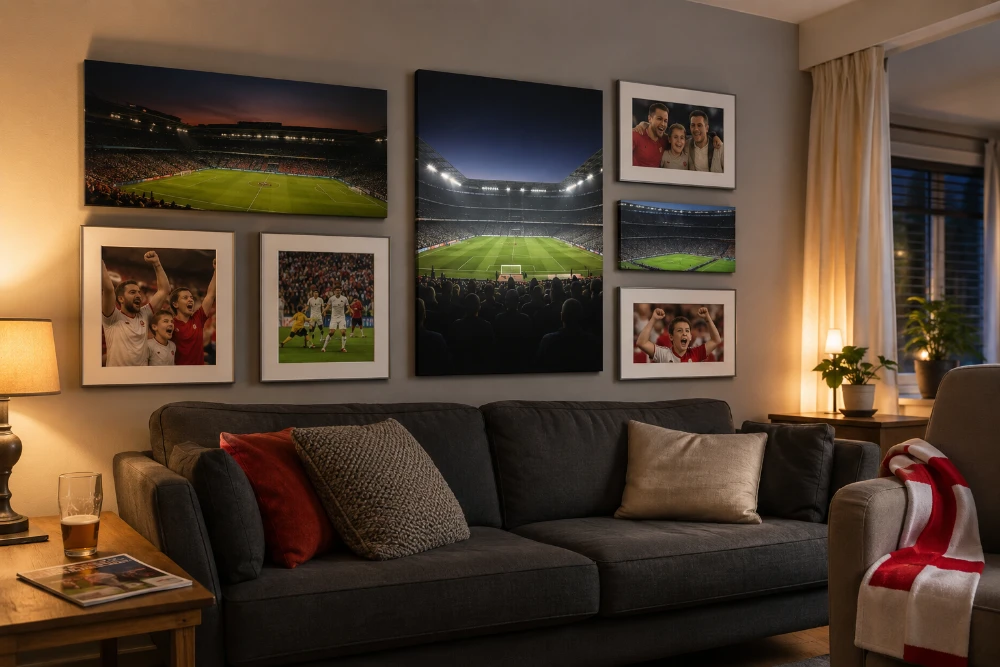
The good news? You don't need an interior designer, a custom framer, or a single tool you don't already own. You need a plan, a clear sense of what kind of fan you are, and about an afternoon of careful measuring. The rest of this article walks you through it.
At a glance: 6 things every great sports gallery wall gets right
| Skim this first — every later section circles back to one of these: |
- It tells one clear story (a tournament, a household, a kid's career, or a fandom) — not a random sampling of every sports photo you own
- It mixes formats — canvas for atmosphere, framed for sentiment, metal for bold detail, photo tiles for the parts that change season to season
- It has one obvious anchor piece, sized generously (usually 24x30 or larger) and placed slightly off-center
- The center sits at 57 inches from the floor — the US museum standard and the natural eye level for adults
- It leaves negative space — prints cover 60 to 70 percent of the available wall, never 100 percent
- It's built to evolve, not freeze in place after the trophy is lifted in July
If you do nothing else, do those six things. Everything below is the longer version.

Pick your wall personality
Before you order a single print, figure out who the wall is really for. Most US sports fans land somewhere in one of four camps. Pick the one that fits — it decides everything from the photos you choose to the formats you pair to where the wall lives in the house.
The Tournament Devotee
Your wall is a one-summer love letter to the 2026 World Cup. The trophy lift is the focal point. Around it sit photos from the matches you watched live, the bars where you watched the rest, and the moments that defined the tournament — your team's run, even if your team is the underdog you only adopted in the round of 16. This wall changes very little after the final. It becomes a permanent record of a single summer that you'll point at for years to come.
Best layouts for this archetype: the triptych anchor, the statement centerpiece, or the stairwell timeline. Lean toward formal: framed prints and canvas, less photo tile rotation.
The Multi-Sport Household
You watch the World Cup, but you also watch the NFL on Sundays, college football on Saturdays, March Madness in spring, and the World Series in October. Your wall is a year-round sports calendar, with the 2026 World Cup as its biggest chapter rather than its only chapter. You swap pieces every season. The wall stays alive because the American sports calendar never really stops.
Best layouts: the stadium row (chronological), the salon-style sports museum (maximalist), or any mix-and-match design heavy on rotating photo tiles.
The Watch-Party Curator
The matches are the excuse. The wall is about the people. Friends crowded into a basement for the late kick-off. The neighbor's kid in a borrowed jersey. The cooler in the driveway during a tailgate. The toddler asleep on the couch with face paint half rubbed off. This is the wall that ages best — five years out, the games are the background. The people are the foreground.
Best layouts: the salon-style sports museum, or any cluster-style layout that lets you weave in unposed candid shots. Heavy on framed prints with white mats for the most meaningful family photos.
The Soccer-Parent Family
Half your phone roll is your kid in a uniform you bought two sizes too big. The 2026 World Cup is about to inspire ten new soccer obsessives in your household. Your wall starts with the tournament and slowly tilts toward youth sports — the first kit, the first goal, the U10 banquet, the day your kid sat slack-jawed in front of a World Cup match for the first time. This is the wall you'll be most grateful for at the high school graduation party.
Best format for this archetype: MIXPIX® photo tiles. The 8x8-inch lightfoam tiles use a Magnofix® magnetic + adhesive disc, so you can swap individual tiles whenever your kid moves up an age bracket — without putting a single new hole in the drywall. The U10 team photo this year becomes the U12 photo next year, and the canvas anchors around them don't have to move.
Pick one before you keep reading. The rest of this guide is meant to be read with one archetype in mind. Mix and match where it makes sense — but don't try to build all four walls at once.
The mixed-format playbook: matching prints to photos
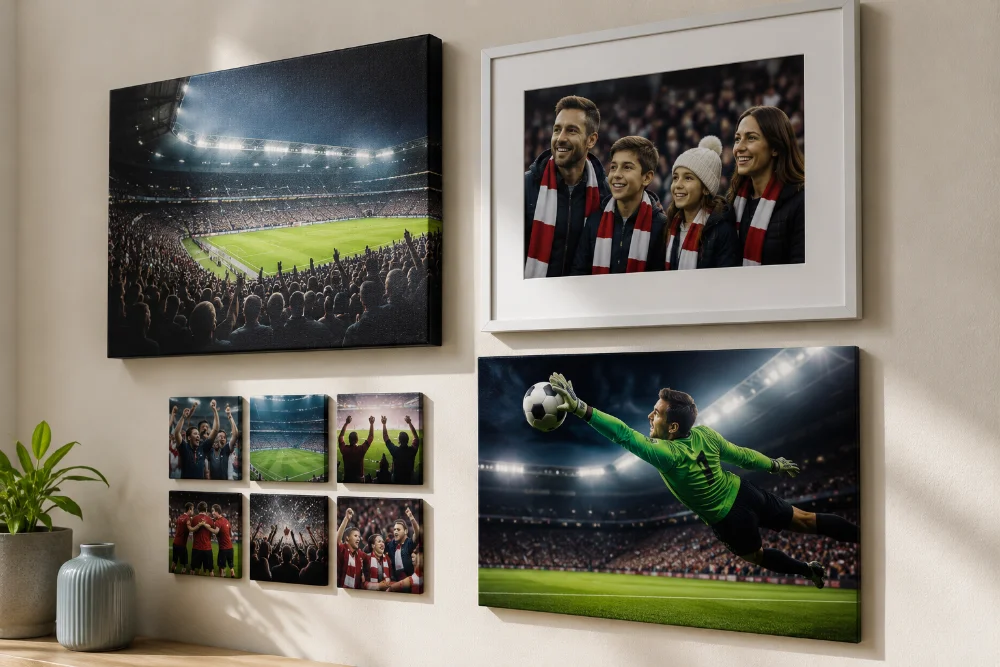
Most home-built sports walls use one format for everything — usually canvas, sometimes framed prints. They end up looking flat, like a hotel hallway. The single most reliable way to make a sports gallery wall look intentional rather than DIY is to mix two or three print formats so the eye keeps finding new textures as it moves across the wall.
Here's which format does what — and why.
Canvas — for the atmosphere
Gallery-wrapped canvas prints are the workhorse of any sports gallery wall. The canvas texture forgives the slight digital sharpness of phone photos in a way that suits action shots, crowd shots, and wide-angle stadium photography. Floodlit night matches at MetLife, golden-hour kick-offs at SoFi, the cooler-and-cornhole shot from the parking lot before kick-off — all of it lands well on canvas.
Practical bonus for sports rooms: canvas doesn't sit behind glass. That matters for any wall you'll look at while watching games — no overhead light reflecting back at you from the gallery during the commercial break. Best sizes: 12x16 and 20x24 for individual photos in a mid-sized arrangement, 24x36 or 30x40 for the centerpiece anchor.
Framed photo prints — for the sentiment
For the most meaningful, personal photos, a framed photo print with a clean white mat gives the image proper weight. A photo of you and your dad at a game. The kid kissing a trophy. Your group on the steps of MetLife after the final. Your wedding-day shot at the stadium. These are the photos that benefit from formality — a real frame, a clean mat, and the protective acrylic glass that comes standard.
The mat matters more than people realize. A white border around the photo signals to the viewer's eye that this is the deliberate, important image — not just another snapshot. On a sports wall full of canvas and metal, the framed prints become the emotional anchors.
Metal prints — for the bold detail
This is the format that gives a sports gallery wall real edge. A metal print on aluminum composite produces images with deep contrasts, rich color, and a clean borderless finish. It suits stadium architecture, jersey and equipment close-ups, action freezes, and any graphic detail shot — the center circle photographed from above, floodlights against a dark sky, a goalkeeper's gloves before kick-off.
Metal prints have a subtle metallic edge that gives them an almost magazine-quality presence. They're also genuinely tough, which matters in a room with kids, dogs, and friends piling in for every big game. One large metal print as the centerpiece of an otherwise canvas-and-framed gallery is a layout we keep coming back to.
MIXPIX® photo tiles — for the parts that change
Soccer is a season-by-season story. Last year's transfer-window heroes are next year's bench. The kid you photographed at U10 is now scoring at U13. A wall that takes a year to drill into and then sits frozen doesn't match the actual rhythm of being an American sports fan, where every weekend brings new games and every fall starts a new season.
MIXPIX® tiles are designed for that rotation. The Magnofix® disc sticks to drywall (or pretty much any clean surface), and the lightfoam tile snaps onto it magnetically. Pull one off, replace it with a new photo, no holes added or moved. Use these for the part of the wall that holds current content — recent match-day shots, current squad standouts, your kid's most recent team photo.
Quick comparison: which format goes where
| Format | Best for these photos | Why it works on a sports wall | Watch out for |
|---|---|---|---|
| Canvas prints | Stadiums, crowds, squad shots, watch-party wide angles | Texture softens phone photos; no glare in TV rooms | Texture flattens fine focus on tight detail shots |
| Framed photo prints | Personal moments, family photos, sentimental anchors | White mat gives image weight; signals "this matters" | Glass can glare under bright living-room lighting |
| Metal prints | Action freezes, jersey close-ups, stadium architecture | Sharp color, borderless modern finish, tough | Contemporary look can clash with traditional rooms |
| MIXPIX® photo tiles | Current-season shots, kids' team photos, anything rotating | Drill-free; swap individual tiles without disturbing the rest | Square 8x8 only; less formal feel than framed prints |
Most successful sports walls use three of these four formats. Pick the two or three that match the photos you actually have.
Where it goes: a room-by-room map for sports walls
Where the wall lives changes what works on it. Six spots in the average American home where sports galleries earn their keep — each one with its own quirks.
Above the couch (the main living room)
The most common spot — and the one where sizing matters most. Spread the arrangement to roughly two-thirds the width of the sofa. For a standard 84-inch three-seat sofa, that's a 55 to 60 inch arrangement. Hang it so the center sits at 57 inches from the floor, leaving 6 to 10 inches between the top of the back cushions and the bottom of the lowest print. Lean toward calmer layouts here — the triptych anchor or the stadium row — because the couch is usually the formal living space, not the dedicated sports room.
Above or beside the TV
Hanging a gallery wall above the TV is divisive. Some designers hate it because the wall has to either complement or compete with the screen all night. The honest compromise: if you watch a lot of sports on that TV, keep the above-TV gallery small and horizontal — a row of three or four prints centered above the screen, no sprawling clusters. Even better, skip the wall behind the TV and put the gallery on the wall beside it, where the eye can move between the screen and the photos without one fighting the other.
Above the fireplace mantel
The fireplace is the single most powerful focal point in any American living room — and the mantel is begging for an anchor piece. Match the arrangement width to the mantel width. Leave six inches between the top of the mantel and the bottom of the lowest print. For this spot in particular, a single 16x20 or 20x24 framed photo print with a clean white mat reads as the emotional center of the room — your most meaningful image, given the most formal treatment.
In a finished basement or den
This is where the design rules relax. Bigger walls, fewer interior-design politics, less competition with formal living-room furniture. The salon-style maximalist layout — 15 to 25 prints in a deliberately loose arrangement — works beautifully in finished basements and dens. So do the bolder formats: a 30x40 metal print on the wall the TV faces becomes the centerpiece of your watch-party HQ. This is also the room where mixing all four formats at once is most likely to land.
In the home office (Zoom-background era)
Since 2020, the wall behind your desk has become a public asset. If you take video calls regularly, a small well-composed sports gallery behind your shoulder — three or four prints, all the same orientation, hung at desk-camera height — is a personality move that doesn't tip into chaos. Skip anything text-heavy: signed memorabilia, programs with detailed lineups, photos with on-screen captions. The camera flattens those into noise. Stick to clean atmospheric shots and one personal anchor.
Up a stairwell
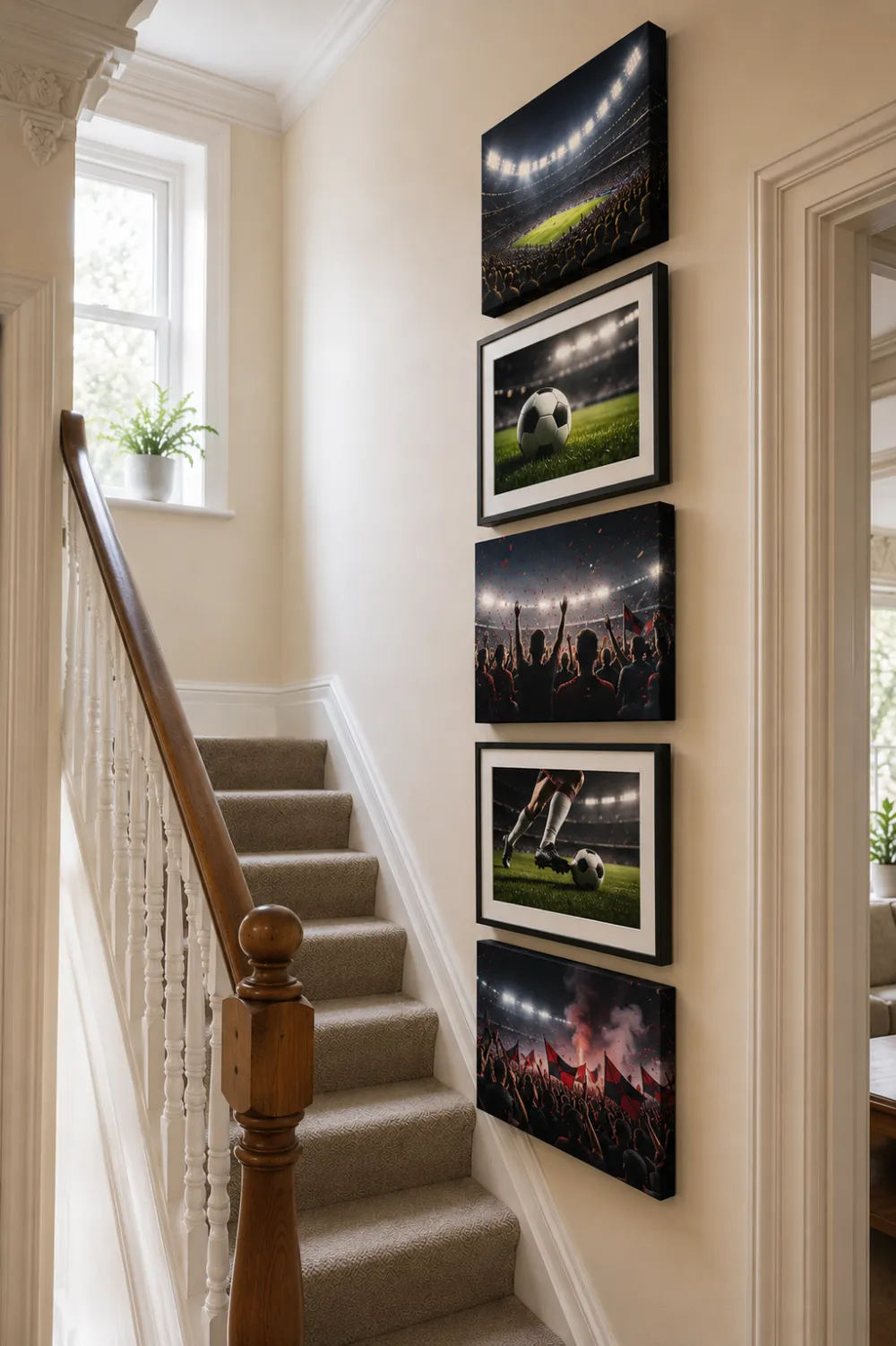
Stairwell walls are some of the most underused real estate in the American home. They want vertical arrangements. A column of four to six prints stacked floor-to-ceiling — one canvas per major tournament across the years, or a tour of the US World Cup host cities from Atlanta to Seattle — uses the height instead of fighting it. The natural diagonal of the stairs gives you an angle to play with: arrange prints so their centers follow the rise.
Sizing made simple: the 57-inch rule and the two-thirds rule
Two rules fix nine out of ten sizing problems on a sports gallery wall. Learn these and you'll skip most of the headaches.
Rule one: the 57-inch rule
The center of your arrangement sits at 57 inches from the floor. This is the standard used by US museums and galleries, and it matches the natural eye level for most adults. The single most common amateur mistake is hanging sports content too high — partly because the photos feel "important," and partly because we instinctively imagine sports memorabilia going where it lives in a stadium concourse (up around the rafters). Resist the instinct. 57 inches is the right number, even when the wall feels half-empty above the arrangement.
Note that this is the center of the entire arrangement, not the center of the top print. If your wall has nine prints in a 3x3 grid, the middle of that grid sits at 57 inches. If you have a tall vertical column of six prints, the center of the column sits at 57 inches.
Rule two: the two-thirds rule
Whatever you hang above a couch, console table, or fireplace mantel should span roughly two-thirds of the furniture's width. Practical numbers:
- Above an 84-inch three-seat sofa: aim for 55 to 60 inches of arrangement width
- Above a 72-inch loveseat: aim for around 48 inches
- Above a 60-inch console table: aim for around 40 inches
- Above a 54-inch fireplace mantel: match the mantel width
Spacing between prints
Keep gaps between prints consistent at 2 to 3 inches. Tighter (1.5 inches) reads denser and more energetic. Looser (3 to 4 inches) reads calmer and more formal. The biggest signal of "amateur" versus "professional" on a gallery wall is inconsistent spacing — pick one number and apply it everywhere. The brain notices unevenness even when it can't articulate why.
Quick size reference
- Anchor centerpiece: 24x30 or 30x40 canvas, 24x36 metal print
- Secondary anchors: 16x20 or 20x24 canvas, 16x20 framed photo prints
- Supporting pieces: 11x14 canvas or framed, 8x10 small canvas
- Rotating tiles: 8x8 MIXPIX®
If you want a fuller breakdown of which standard US sizes fit which spaces, our guide to standard picture frame sizes runs through every common American frame size and what works in which room.
Six layouts that actually look good in American homes
Six named layouts cover almost every sports gallery wall worth building. Pick one to start with — you can always evolve it later.
The Triptych Anchor
Three matching canvas prints in a horizontal row sit as the anchor — typically the build-up, a key match moment, and the celebration. A looser cluster of 5 to 7 smaller framed photos and photo tiles fills out the wall around and below the triptych.
Why it works: the formal triptych gives the eye a focal point; the cluster adds the personal feel. Best for above-couch walls, 6 to 8 feet wide. Total coverage roughly 5 by 4 feet.
The Statement Centerpiece
One oversized metal print (24x36 or larger) sits dead center. Smaller canvas and framed prints flank it symmetrically — three or four on each side.
Why it works: the metal piece grabs attention; the supporting cast provides depth and context. Best for feature walls 8 to 11 feet wide, particularly above a fireplace or in a finished basement.
The Stadium Row
A single horizontal row of 5 to 7 prints at one consistent center height. Mix sizes within the row — alternate 11x14 portrait with 14x11 landscape — but keep every center on the same line.
Why it works: rows read as deliberate timelines, which suits the chronological tournament-storytelling angle perfectly. Best for rooms with lower ceilings or above a long console table or radiator cover.
The Squad Grid
Nine square prints in a perfect 3x3 grid. Can be MIXPIX® tiles, mini canvas prints, or — for one integrated piece — a collage canvas print that combines multiple photos into a single composition. Black-and-white treatment across all nine photos makes it especially striking.
Why it works: the geometric repetition feels modern and considered. Best for contemporary or minimalist rooms, or as a cleaner alternative to a sprawling salon-style wall.
The Salon-Style Sports Museum
The maximalist option. 15 to 25 mixed prints covering most of a feature wall in a deliberately loose arrangement. Everything goes — the trophy lift, the sports-bar shots, the kid's first jersey photo, the road-trip group shot, scanned tickets and programs.
Why it works: when done well, salon-style walls feel like a properly curated personal museum. The trick: start with the largest piece, place it slightly off-center, and build outward keeping spacing consistent. Best for dedicated sports rooms, basements, man caves, and any feature wall 11 feet wide or more.
The Stairwell Timeline
A vertical column of 4 to 6 prints stacked floor to ceiling. Works for chronological storytelling — one canvas per major tournament across the years, or one print per US host city you visited during the 2026 tournament.
Why it works: tall stairwells are hard to fill with traditional landscape art. A vertical sports timeline uses the height instead of wasting it. Best for stairwells, tall narrow walls, anywhere with awkward verticality.
The paper template trick — before you drill anything
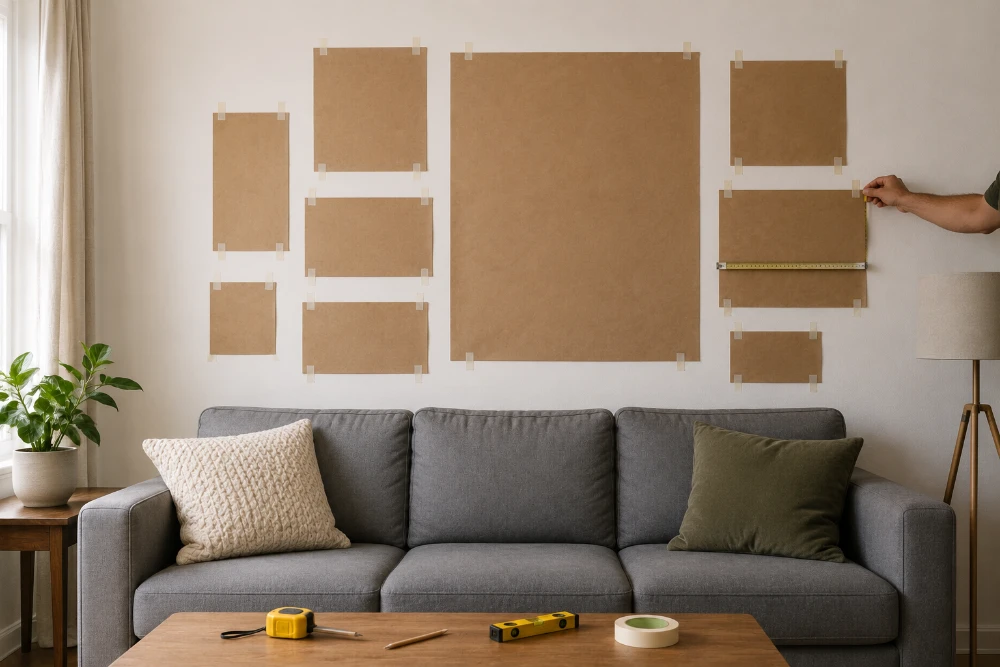
Before you put a single hole in the wall, cut newspaper or kraft paper to the exact size of every print and tape them to the wall with low-tack painter's tape. Stand back. Look from across the room and from the couch. Live with it for a day or two.
Move things around. Swap the anchor for one of the smaller pieces and see if it works better. Try tighter spacing. Try looser. This is the single best way to avoid the most common gallery-wall mistake — putting photos in nearly-the-right places and never quite being able to fix them.
For more layout ideas with templates and visual examples, our 100+ gallery wall ideas guide covers more than 100 specific arrangements across every room of the house.
From phone roll to printed wall: a watch-party-to-wall workflow
Most of the photos that end up on a sports gallery wall live on a phone. The workflow from photo to print is its own little project — and getting it right is the difference between a wall that looks curated and one that looks like a screensaver.
Sort by date, not by vibe
Open your phone gallery and search by the tournament dates — for the 2026 World Cup, that's June 11 to July 19. Pull every photo from that window. Don't curate yet. The instinct is to filter for "good photos" right away, but you'll lose the best candid moments if you start judging too early. The slightly out-of-focus celebration shot is often the keeper.
Scan the analog stuff
Match-day programs. Tickets. Autographed cards. Even the napkin from the sports bar with the bracket someone drew on it. Photograph them flat against a plain background in good natural light, or use the scanner function in your phone's notes app. Analog scans print beautifully on canvas and add the curated-archive feel that sets the best sports walls apart.
Crop for the format before you upload
Square photos for MIXPIX® tiles. Portrait orientation (16x20, 11x14) for framed prints and individual canvas anchors. Wide horizontal for stadium panoramas and the triptych anchor pieces. Crop in your phone's editor before you upload — it's much faster than fixing in the print preview, and you'll spot composition problems earlier.
Resolution check
A modern phone (iPhone 12 or later, Galaxy S21 or later) handles canvas prints up to 24x36 without trouble, provided the photo was well lit. Heavily zoomed shots from the upper deck of a stadium almost never enlarge well — they pixelate. For larger prints, use unzoomed wide shots and crop in software afterward. As a rule of thumb:
- 8x10 prints: any decent phone photo from the last six years works
- 16x20 prints: need at least 1,600x2,400 pixels — fine for most modern phones in good light
- 24x30 prints and larger: need roughly 2,400x3,200 pixels — daylight or stadium floodlit shots from recent flagships
Multi-photo prints for a sequence
If your favorite memory of the tournament is a sequence — the build-up, the goal, the celebration, the aftermath — putting all four into a single composition can sometimes hit harder than four separate small prints scattered across the wall. The collage canvas print format mentioned earlier handles this well: one piece, one composition, four moments.
Hanging it in a real American home
The standard build in most US homes is drywall over wood studs, 16 inches apart on center. But the right hanging method changes depending on what's behind the paint — and getting this wrong is why some gallery walls end up on the floor at 2 a.m.
Drywall with studs
The strongest hold is into a stud. Use a stud finder — the magnetic ones miss; spend the extra $15 on an electronic one with a deep-scan mode — and a 1.5-inch wood screw. For anything heavier than 5 lbs, hitting a stud matters. For lighter prints, you can hang anywhere on the drywall using the right anchor.
Drywall between studs
Most positions on a wall won't line up with a stud. Use a drywall anchor rated for the print's weight. Plastic expansion anchors handle anything under 5 lbs. Self-drilling threaded anchors (E-Z Ancor and similar) handle up to 25 lbs. Toggle bolts handle anything above that. Don't trust an unbranded anchor with a heavy metal print — the failure mode is the print falling overnight without warning.
Plaster and lath (pre-1950s homes)
If you live in a brownstone in Brooklyn, a triple-decker in Boston, or any other pre-war home, the walls are probably plaster over wood lath. Plaster is brittle. Pre-drill a pilot hole and use a screw with a butterfly toggle. Don't use an impact drill — the vibration cracks plaster, and the cracks are a pain to patch.
Brick and concrete (basements, lofts)
For brick or concrete walls — common in unfinished basements and converted loft spaces — use a 1/4-inch masonry bit and a concrete anchor. Mark the drill location with a piece of painter's tape to keep the bit from wandering at the start of the hole.
Weight check
A 12x16 canvas weighs around 1 lb. A 24x30 canvas weighs around 3 lbs. A 30x40 metal print can hit 6 to 7 lbs. A standard picture hook handles up to 5 lbs. For anything heavier, use a proper screw and anchor — and for prints over 24x30, use two fixings rather than one to keep the print from tilting when something brushes against it.
For metal prints specifically, the hardware is a little different — they ship with their own hanger plate or aluminum backframe. The how to hang metal prints guide walks through both systems step by step.
The renter's playbook
If you can't drill — or you don't want to argue with your security deposit — four options cover most cases:
- Command Strips (3M) hold prints up to about 4 lbs. Wipe the wall with rubbing alcohol first, press for 30 seconds, wait an hour before hanging.
- MIXPIX® photo tiles use a Magnofix® disc designed to peel off cleanly when you move out. You can take the whole wall with you to the next apartment.
- For lightweight content, custom poster prints on premium photo paper work brilliantly with poster putty or removable mounting strips — useful for filling out a salon-style wall in a rental without putting a single hole in the drywall.
- Picture rails — if your building has them, you're set. Pre-war apartments in Boston, Philadelphia, Chicago, and San Francisco often do. Brass hooks and adjustable wire from any hardware store. Zero wall damage, infinite adjustability.
The level rule
It takes 30 seconds to check a print is straight. If it isn't, you'll notice every time you walk into the room. Use a real bubble level — the smartphone apps aren't reliable enough for gallery work.
World Cup 2026: a planner's calendar for your wall
If you're building this wall in real time as the tournament unfolds, here's the rough timeline of when each phase happens — and what to photograph along the way.
- June 11 — Opening match (Mexico City). Watch-party photos, kit and scarves out, kids in the new jerseys. This is the day the tournament wall starts.
- Mid-June — Group stage. Sports bar shots, USMNT moments, family-on-the-couch photos during the day matches, tickets and programs from any games you attend in person.
- Late June — Round of 32 and round of 16. Atmospheric shots get more dramatic — fans tense, mid-match nail-biting, full-room celebrations after late goals.
- Early July — Quarter-finals and semi-finals. Anchor-piece moments. If a team you follow makes it this far, print these photos biggest.
- July 19 — Final at MetLife Stadium, NJ. Trophy lift, final-whistle reaction, the post-match scene. The lifted-trophy photo is almost always the wall's centerpiece.
- September — NFL season opener. Bridge content begins. Tailgate shots, first home game, kid in the new fall jersey.
Don't wait for the final to start building. Start with paper templates and three or four placeholder prints on June 1. Add as the matches roll in. Finalize the canvas and framed anchors in late August once the last group-stage scans are in. The wall lives in flux during the tournament, and that's part of the experience.
Where most home-built sports walls go wrong
The mistakes are surprisingly consistent across thousands of finished walls. Five worth actively avoiding.
1. Hanging everything too high
Your couch-eye-level is around 45 inches from the floor. The center of your gallery wants to be at 57 inches — not 65. Sports memorabilia tempts you to hang it higher, like a display in a stadium concourse or a sports bar. Resist. A wall that feels too high makes the room feel cold; one hung correctly disappears into the daily rhythm of the space.
2. Identical sizes, identical formats
A wall of nine 16x20 canvas prints all hung the same way reads as a hotel hallway. Vary the size of every other piece, and mix in at least one different format. The eye wants variation. Without it, the wall flattens out and stops earning attention.
3. No clear anchor piece
Without one piece that's obviously the largest and most important, the eye has nowhere to land. Pick your anchor — the trophy lift, or the squad photo, or your kid with the U10 trophy — and print it bigger than everything else. Place it slightly off-center, not dead center, so the wall reads as composed rather than balanced like a logo.
4. Inconsistent spacing
Two inches between two prints, four inches between the next two, three inches between the next. The brain reads this as careless even when it can't quite articulate why. Pick one number — 2.5 inches is the sweet spot — and use it everywhere on the wall, every time.
5. Filling 100% of the wall
Sports galleries should cover 60 to 70 percent of the available wall, not all of it. The negative space around the prints is what makes the arrangement read as a gallery rather than a flea market. If your wall is feeling cluttered, the answer is almost always to remove two pieces, not to add one more.
Evolving your wall through the year
The most successful sports gallery walls we see are built to evolve, not to freeze. The trophy lift and the squad photo stay forever. Everything else rotates.
A typical American sports year for the wall looks something like this:
- August: Swap in tailgate and pre-season shots from the upcoming NFL season
- October: Add World Series content if your team makes the postseason; college football is in full swing
- November: Thanksgiving rivalry weekend, the football-on-the-couch family shot
- December: Bowl game and college football playoff content; NBA Christmas Day games
- March: March Madness brackets, your office pool, the late-game watch party
- May: Your kid's spring soccer team photo, end-of-season Little League shot
- June: Whichever international tournament is on next — Gold Cup, Euros, Copa America
MIXPIX® tiles make this rotation painless because individual tiles swap without disturbing the canvas and framed anchors around them. Three or four tiles set aside for "current season" content keep the wall feeling alive year after year.
Closing thoughts
The 2026 World Cup is going to give you the most concentrated five weeks of sports memory-making in a generation, played out across stadiums you can actually drive to. A gallery wall is the one piece of decor that can absorb all of it — and keep absorbing the seasons after.
Pick your wall personality. Mix two or three print formats. Use the two-thirds rule for sizing and the 57-inch rule for height. Use the paper template trick before you drill anything. Build to evolve, not to freeze in July.
The tournament ends on July 19. Your wall doesn't have to.
Frequently Asked Questions About Sports Gallery Walls
-
For a typical above-couch wall in an American living room, 7 to 12 prints in a focused arrangement is the sweet spot. For a feature wall in a finished basement or dedicated sports room, 15 to 25 works better. Fewer than 5 looks sparse. More than 25 needs to be in a salon-style maximalist layout to feel deliberate rather than overwhelming.
-
The total arrangement should span roughly two-thirds of the sofa's width. For a standard 84-inch three-seat sofa, that means 55 to 60 inches of total wall coverage. Use one anchor piece at 24x30 or 30x40 canvas (or 24x36 metal), with smaller prints in 11x14 and 8x10 building outward from it.
-
Mix all three for the strongest result. Canvas works best for atmospheric crowd and stadium shots — the texture forgives phone photos. Framed prints with white mats suit personal, formal, or sentimental moments. Metal prints look brilliant for bold action shots and jersey close-ups. A wall using one format for everything tends to look flat — variety is what makes the gallery feel curated rather than mass-produced.
-
2 to 3 inches between prints is the standard gallery spacing in the US. Tighter (1.5 inches) makes the wall feel denser and more energetic. Looser (3 to 4 inches) feels calmer and more formal. Pick one spacing number and apply it consistently across the whole wall — inconsistent spacing is the single biggest signal of an amateur arrangement.
-
The center of the entire arrangement should sit at 57 inches from the floor. This is the standard used by US museums and the natural eye level for most American adults. Above a sofa or console table, prioritize leaving 6 to 10 inches between the top of the furniture and the bottom of the lowest print, even if that pushes the center slightly higher than 57 inches.
-
Yes — and easier than you'd think. Three options cover most cases. Command Strips (3M) hold prints up to 4 lbs. MIXPIX® photo tiles use a Magnofix® adhesive disc that peels off cleanly when you move out. Lightweight custom poster prints work with poster putty for the parts of the wall you want to swap out frequently. If your building has picture rails (common in pre-war buildings in Boston, Philadelphia, Chicago, and San Francisco), use brass hooks and steel wire for zero wall damage.
-
For modern smartphones — iPhone 12 and later, Galaxy S21 and later — yes, easily. Phones today have enough resolution for canvas prints up to 24x36, provided the photo was well-lit. The exception is heavily zoomed shots from the upper deck of a stadium; those almost never enlarge well. For larger prints, use unzoomed wide shots and crop in software afterward.
-
Absolutely. This is one of the most natural sports gallery wall concepts — the World Cup is the inspiration, your kid's progression is the long-term story. The wall ages beautifully because the World Cup photos become historical context and your kid's team photos become the living, current content. Use MIXPIX® tiles for the kid's section so you can swap them out each season as they grow.
-
For metal prints over 5 lbs (most prints 20x24 and larger), aim for a stud whenever possible. Use a 1.5-inch wood screw straight into the stud. If the position you want isn't on a stud, use a self-drilling threaded anchor (E-Z Ancor or similar) rated for at least 25 lbs, or a toggle bolt for the heaviest pieces. Metal prints ship with their own hanger plate or aluminum backframe — install the wall hardware first, then hang the print onto it.
-
Only if you treat it as a one-summer installation. Keep the anchor pieces (the trophy lift, the squad photo, the family stadium shot) and rotate in NFL, MLB, college sports, or youth team content as the rest of the sports calendar unfolds. The most successful sports gallery walls we see are designed to evolve — the World Cup becomes one chapter of a long-running story rather than the whole book.
-
Yes, and especially for personal content like sports photos. Gallery walls have shifted away from the matching mass-produced-print look of the 2010s toward more personal, curated arrangements that mix formats, sizes, and content. A sports gallery wall built around your own photos sits firmly in the current US interior design trend.
-
Photograph or scan them flat against a plain background in good natural light, or use your phone's scanner app. Program covers scan particularly well because the print quality on most match programs is decent enough to enlarge. Tickets are smaller and need slightly more care — photograph at high resolution, crop tightly, and they print beautifully on small framed prints (5x7 or 8x10) or as part of a MIXPIX® tile cluster of memorabilia.
-
Absolutely — this is the multi-sport-household angle in action. A consistent color treatment (all black-and-white, or all in the same warm-toned filter) ties the different sources together. The wall ends up feeling like a proper personal sports timeline rather than a single tournament's snapshot. College football tailgates, March Madness brackets, MLB Opening Day shots, and the World Cup all belong in the same gallery if they're all part of your sports year.
-
Keep it small and horizontal. A row of three or four prints centered above the screen, all the same orientation, works much better than a sprawling cluster that competes with the TV. Even better: put the gallery on the wall beside the TV instead of above it. That way the eye can move between the game and the photos without one fighting the other for attention.
