How to Photograph Soccer Crowd Celebrations: A Smartphone Guide for US Fans in 2026
 by Ashley Carter
 10 Minutes
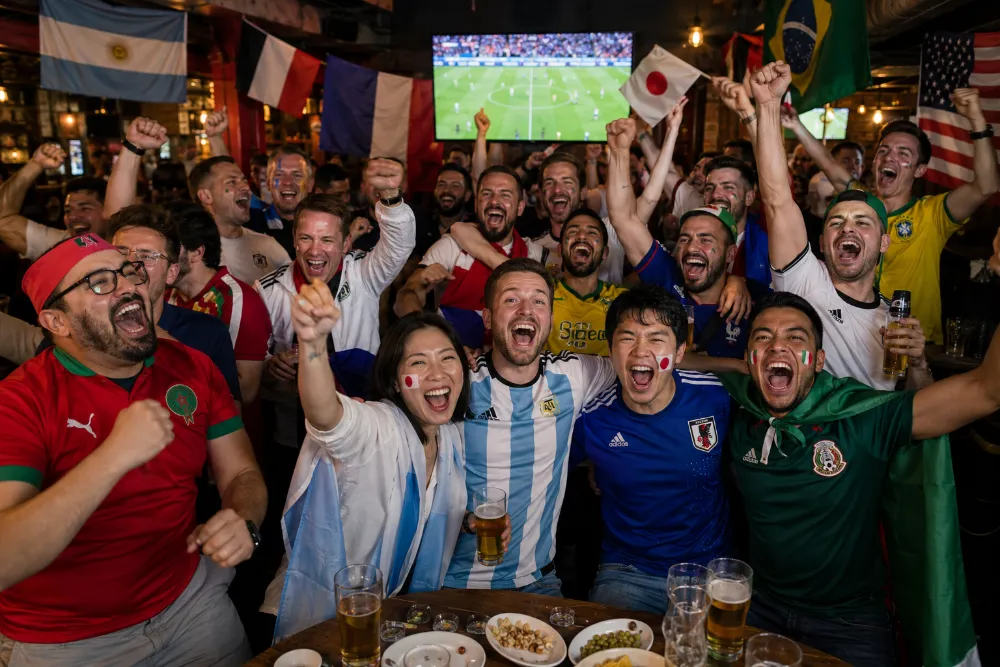
There's a specific moment, about half a second after a goal, when every face in the room changes at the same time. Eyes go wide. Mouths drop open. Hands hover halfway between the table and the air. Beers tilt. Someone's already on their feet.
That's the photo. The one you'll look back at in twenty years and remember exactly where you were, who was sitting next to you, what the room sounded like.
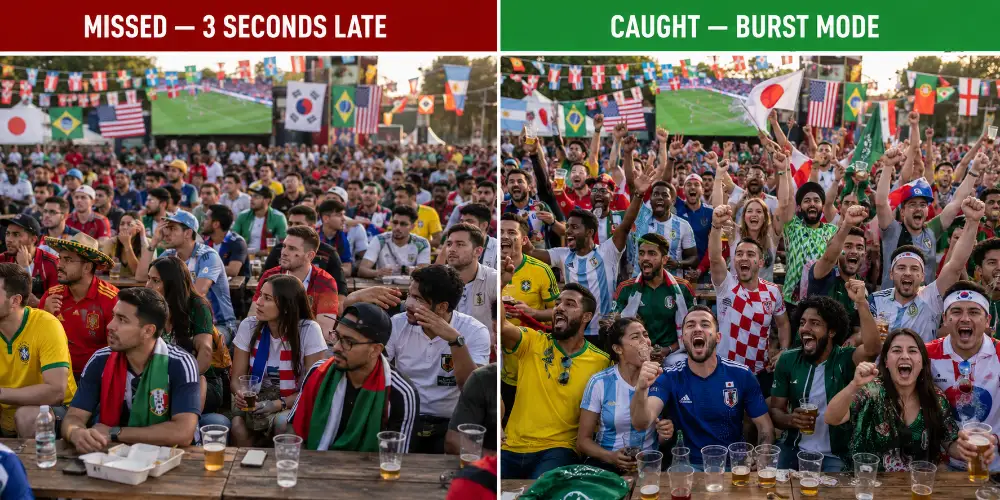
And almost everyone misses it. They're watching the screen, not the people. By the time they reach for their phone, the moment has passed — and what they end up with is a blurry shot of someone's back, taken three seconds late, completely out of focus.
This guide is about not missing it.
We're going to walk through how to capture the noise, the chaos and the genuine emotion of soccer crowd celebrations on your phone — wherever you happen to be watching. Settings to change before kickoff. Where to point the camera and when. How to be in the photo when you're also the one taking it. And once you've got the shot, what to do with it so it doesn't just sit in your camera roll until your phone dies in 2034.
Key takeaways
Short on time? Here's the whole guide in seven lines.
- Burst mode is the single most important setting. Twenty frames give you one keeper. One careful shot gives you nothing.
- Point at the faces, not the screen. The goal will be on ESPN later. The reaction is on those faces, in that room, this one time only.
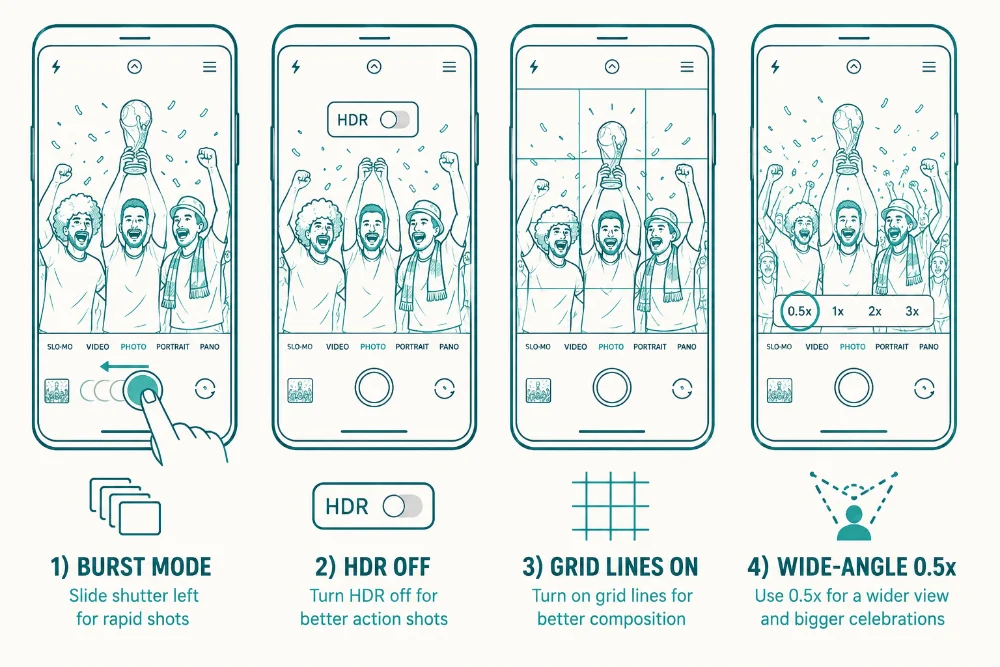
- Turn off HDR, Night mode and the flash before kickoff. All three ruin moving subjects, in different ways. Grid lines on, 0.5x wide-angle lens for groups in good light.
- Pick the photographer deliberately. The right person is sober-ish, has a recent phone, and isn't too emotionally invested in the game.
- Plan one shot of yourself per game. Front camera with arm raised, ten-second timer with the phone propped, or hand it to someone at the next table.
- The keeper has open eyes, open mouths and movement. Slight motion blur on hands is fine — it reads as energy, not as a mistake.
- Turn the keeper into something you'll actually use. A photo mug, a canvas, a photo book of the whole summer. The 2026 soccer summer won't last forever — but the keepsakes you make from it can.

Why soccer celebration photos are different
Most photos on your phone are static. A coffee. The dog. A view from a hotel window. They sit there fine, but no one's going to ask to see them.
Goal celebration photos are different. They have movement, sound (you can almost hear the room from a good shot), and pure emotion frozen on real faces. People who never photograph well — the friend who blinks in every wedding photo, the dad who refuses to smile for cameras — suddenly look extraordinary, because they've forgotten the camera exists.
The 2026 international soccer summer is the biggest one ever staged in the US. 48 teams, six weeks of games, three host countries — and for the first time in a generation, the US is right in the middle of it, with stadiums hosting matches from Los Angeles to Boston. That's a lot of late nights, nervous group stages, and moments when the room goes properly wild. If you want one photograph from the summer that earns its place on a wall (or a fridge, or a coffee table, or in your pocket), the celebration shot is the one.
Set up your phone in 60 seconds before kickoff
Most phone cameras come out of the box with default settings that are wrong for celebration photography. Three minutes of tweaking before kickoff is the single best investment you can make in your tournament photo album.
Turn on burst mode (the most important setting on your phone)
Burst mode is the single most useful feature you can use for celebration photography. It takes around ten photos per second for as long as you hold the button — so in five seconds you have 50 frames of the goal reaction, and one of them is going to be the keeper.
On iPhone (iPhone 11 onwards): tap and hold the shutter button, then slide it to the left. The camera fires shots until you let go. To make burst even easier, go to Settings → Camera → and turn on "Use Volume Up for Burst." Now holding the volume-up button on the side fires the burst, which is much easier to grip steadily during a chaotic moment.
On Samsung Galaxy and most Android phones: press and hold the shutter button, or in some models swipe the shutter down. If your camera doesn't seem to do this, dig into the camera settings menu — most have a "Shooting Methods" or "Burst" option that needs to be enabled once.
Fifty frames is genuinely excessive — you won't need more than fifteen for a good shot — but the option to keep going is there for the moments where the celebration keeps building, like a winning goal in extra time.
Turn HDR off
HDR sounds like a good idea. The phone takes several photos at different exposures and merges them. The problem is that takes time. If anyone in the frame moves between the merged shots, you get ghosting and blurring at the edges of every figure — which is what happens during every soccer celebration ever.
On iPhone: Settings → Camera → Smart HDR → off. On Samsung and Android: look in the camera settings for "HDR" and toggle it to off or "Auto only."
You can turn it back on after the game if you remember. Most people don't, and their phone photos quietly improve from then on.
Switch on grid lines and learn the rule of thirds
The grid is the single best aid to composition that exists on a phone. Three lines down, three lines across — the rule of thirds, which is the foundation of how good photographs are framed. Place the most expressive face on one of the four points where the lines cross, rather than dead center, and the photo immediately looks more deliberate.
The same principles pros use — rule of thirds, leading lines, framing — apply just as much to a phone snap in a sports bar as they do to a magazine cover. If you want to dig deeper into how phone shots translate to wall art, printing phone photos on canvas covers what makes a phone shot print-ready and how to crop it for different sizes.
On iPhone: Settings → Camera → Grid → on. On most Android phones: open the camera, tap the gear or settings icon, find "Grid lines" or "Composition guides."
Use the wide-angle (0.5x) lens for groups
Modern phones have multiple lenses. Most people stick to the default 1x main lens because it's what opens automatically. For a celebration with eight or ten people erupting in different directions at once, that's wrong.
The 0.5x ultra-wide lens fits more of the room into the frame. Tap the small "0.5" button at the bottom of the screen, near the shutter, and you'll see the view zoom out. The image will look slightly warped at the very edges (this is normal for ultra-wide lenses) but the warping is barely noticeable in a celebration shot, and it's a worthwhile trade for getting everyone in.
One catch: the 0.5x lens is generally the lowest-resolution lens on the phone, and it struggles in very dim light. If you're in a properly dark sports bar, drop back to the 1x main lens and accept a tighter crop on the celebration. We'll come back to lighting in a minute.
Settings to leave well alone
- Portrait mode: don't use it for groups of more than four or five people. The phone gets confused about which faces are in focus and starts artificially blurring people, often the wrong ones.
- Night mode: turn it off. Night mode takes long exposures, which means anyone moving comes out as a ghost. For a goal celebration, where everyone's moving, this is a disaster.
- Flash: never. The flash on a phone is harsh, kills the warm sports bar atmosphere instantly, and reduces every face to a deer-in-headlights expression.
- Filters: don't apply them before taking the shot. You can edit afterwards from the original — but you can't un-filter a shot you've already filtered.
The one rule that changes everything: watch the faces, not the screen
This is the single most important thing in this guide, and most people get it wrong.
When you want to photograph a celebration, you have to stop watching the game.
That sounds painful, and it is. But here's the math. The actual scoring happens in maybe one second — the ball hits the net, the whistle blows. The reaction lasts five to ten seconds and is far more interesting than the goal itself. The goal will be on ESPN, on every highlight reel, and in your sports app within twenty minutes. The reaction is on those faces, in that room, this one time only.
So one person needs to take photographer duty. Pick someone deliberately rather than letting the loudest person in the group default into it. The right person is:
- Reasonably sober, relative to everyone else
- Has a phone with a recent camera — iPhone 13 onwards or a Samsung Galaxy S22 onwards is the safe zone, though older phones are fine in good light
- Willing to fire off bursts of fifteen or twenty shots rather than one careful click
- Not particularly emotionally invested in the game (the heartbroken USMNT fan is a bad photographer)
- Comfortable putting their phone in everyone else's face for a few seconds
If your group has someone who actually takes photos as a hobby, recruit them well in advance. Buy them a beer. Make it official. They'll appreciate having a job and you'll get vastly better photos than if everyone is freelancing on their own phones.
Capturing the goal: timing the burst
You've got your settings sorted. The game is on. Now what?
The goal moment is the highest-stakes shot in soccer photography. It happens once or twice in a game if you're lucky, lasts about three seconds, and can't be reshot. Here's how to actually nail it.
Anticipating the moment
You can't just hold the shutter button down for the entire 90 minutes. Your battery will be dead by halftime and you'll fill your phone with 50,000 photos of nothing happening. You need to know when to start the burst.
Watch the game for cues. Goal-scoring moments are usually preceded by something visible: a corner kick, a counterattack, a free kick from a dangerous position, a striker through on goal. The room often reacts before the ball is in the net — a low collective gasp, leaning forward, hands hovering near mouths. That's your signal. Start the burst right then.
A good rule: the moment the ball is being struck toward goal, your finger should already be on the shutter button. You'll get five seconds of buildup footage and then ten seconds of either celebration or groan. Either way, you've got it.
Where to point the camera
Not at the screen.
This is the most common rookie mistake. People want a photo of the moment the goal goes in, so they film the TV. The result is a slightly blurred shot of a televised goal that looks like every other shot of a televised goal in history.
The camera should be pointed at the room — at faces, at the group, at the chaos. The TV is a backdrop, at most. If you can frame the shot so the screen is just visible in the corner showing the green field, that's brilliant context. But the people are the subject. The TV is supporting cast.
Holding the phone steady in a packed sports bar
In a small sports bar with the room going off, holding a phone steady feels almost impossible. A few tricks help:
- Tuck your elbows in. Pinning your elbows tight against your ribs gives the phone a stable platform — much steadier than holding it out at arm's length.
- Use both hands. Right hand on the shutter, left hand cupped under the phone for support.
- Lean against something. A wall, a chair back, a friend's shoulder. Any solid surface stabilizes the shot — the few seconds spent finding one are worth it.
- Use the volume button. If you set up "Use Volume Up for Burst" earlier, you can keep the phone in a relaxed grip and just press the side button. Far less wobble than poking at the screen.
What a great goal celebration shot looks like
When you sift through your fifty burst frames afterward, you're looking for very specific qualities. The keeper shot usually has:
- At least three faces fully visible (not blocked by arms or backs of heads)
- Mouths open mid-shout, not closed in a polite smile
- Eyes open and looking up or sideways at the screen — closed eyes are usually a bin
- Some movement — arms in the air, someone leaping, scarves flying — to convey the energy
- A clear central focal point: usually the most expressive face in the group
It almost never has perfect focus on every face. Some movement blur on hands and arms is fine and actually helps the photo feel alive. Razor-sharp focus on a still subject would look posed and dull.
What to do with the keeper
Once you've found the brilliant frame from the burst, decide there and then to do something with it. The trick is to pick a format you actually pick up rather than one you stop noticing.
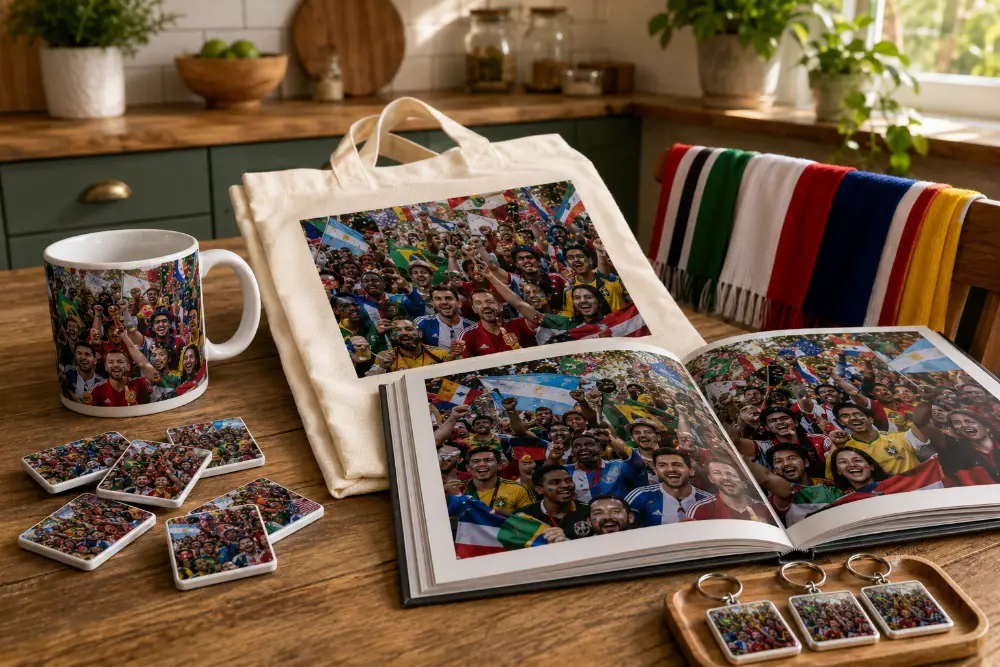
A personalized photo mug is one of the most natural homes for a celebration shot, for a reason most people miss: you hold it every morning. The moment your team scored, in your hand at 7:45 on a Tuesday in October, while the coffee is still brewing. These are printed in the US using heat-sublimation, which fuses the ink into the surface so the image stays bright through years of dishwasher cycles. A mug each for the people in the shot is the kind of group gift that genuinely gets used — far more than a printed calendar that gets stuck in a drawer.
The wider crowd: capturing the wave, not just one face
The single goal-moment shot is one type of celebration photo. The other type — the crowd wave — is what happens at the bigger venues: outdoor watch parties, packed sports bar patios, stadium concourses. Hundreds of people moving as one. This needs a slightly different approach.
Two ways to shoot a crowd wave
At an outdoor watch party or stadium concourse, when a goal goes in, the celebration ripples through the crowd. Hands go up in pockets first, then spread, then peak, then fade. The whole sequence takes maybe six seconds.
Two approaches both work well:
- Shoot from inside the crowd: You're part of the wave. Hold the phone above your head, lens pointing down and slightly forward, and fire a burst. You'll get a sea of arms and faces from a height nobody else is shooting from. Wide-angle (0.5x) is essential for this, and you'll need to crop in afterward to clean up the framing.
- Shoot from the edge: Stand back from the main crowd and shoot across or into it. You get a wider view that captures the scale of the celebration, with a clear horizon line and a recognizable backdrop (the bar, the stage, the screen). This shot tells a different story — less "I was there" and more "look at this." Wide-angle works here too, but you can use the 1x lens if there's decent light.
The single face in the chaos
Sometimes the best photo isn't the wide crowd shot — it's one face in the middle of the chaos. Pick out one person reacting (a stranger you've never met, your own dad, a kid on someone's shoulders) and frame them tight while the celebration explodes around them.
This is the iconic newspaper-photographer shot. One person, mid-emotion, with the rest of the crowd just out of focus behind them. It works because the eye knows exactly where to look, and the energy of the wider scene is implied rather than spelled out.
The 1x lens (or even 2x telephoto if your phone has one) is the right choice here. Burst mode still on. Shoot through the crowd, looking for an unposed face that has truly let go.
Carrying your kit to the watch party
Outdoor watch parties and sports bar patios aren't casual trips. You tend to arrive with stuff — a folded hoodie in case the AC is brutal, a water bottle, a power bank for everyone's dying phones, sunscreen for the kids, snacks. By the seventh game of the tournament, you've got a routine.
A custom photo towel is one of the most practical items you can pack — especially for the US summer games, where afternoon kickoffs in Texas, Florida or Southern California can mean 95°F in the shade. Print one with your group's photo or a country flag and it does triple duty: a sweat towel, a sun shade for the kids, and a quick mop-up if a beer goes flying mid-celebration. The microfiber dries fast, packs small, and comes home in your bag a week later to live in the gym locker for the next decade — every workout, a small reminder of the summer.
Where you watch changes how you shoot
Where you happen to be watching the game changes everything about how the photo will turn out. Four common US situations, four different sets of tricks.
The American sports bar
The most common US watch spot, and the trickiest for photography. Warm tungsten lighting, TVs mounted high above eye level, often crowded, the screen is the brightest thing in the room. Most sports bar photos come out looking dim, orange, and slightly out of focus.
- Stand near the window or front door. Even on a gray afternoon, daylight is brighter and more flattering than tungsten bar bulbs. Move the group toward the window before the moment, not during.
- Avoid backlighting. A window directly behind the group turns everyone into silhouettes. The window should be to one side, lighting faces from an angle.
- Find the brightest corner during your first round. Most sports bars have one corner that's naturally better-lit than the rest. Identify it early so you can drag people there for the halftime photo or the post-game celebration.
- Use the 1x lens, not 0.5x. The wide-angle lens performs poorly in dim light — the photos come out grainy and soft. The main lens has a larger aperture and copes much better.
The home watch party
Living room, big TV, sofa full of people facing the screen. The TV is now the dominant light source, throwing weird blue-white light onto half the group while the other half is in shadow. Plus, you can't easily move people during a tense moment.
- Pause the game at halftime, turn the room lights on. A side lamp with a fabric shade is the best home lighting for groups — soft, even, flattering. Get the photo in the gap between halves, not during play.
- Position yourself between the TV and the group. When you do shoot during the game, stand with your back to the screen so the TV becomes a soft glow behind you, lighting the front of the group rather than blasting them from behind.
- Avoid overhead spotlights. Down-lighting from a single ceiling light creates harsh shadows under eyes, noses and chins. Switch to lamps where possible.
- Watch for the post-goal hug. Living room celebrations often peak about three seconds after the goal — the room exhales, then leans in and hugs. Burst through it, don't stop after the initial reaction.
The outdoor watch party (city fan zone, sports bar patio, backyard)
Outdoor or partly outdoor venues with a big screen, communal seating, and a crowd of strangers alongside your own group. Generally the best photographic conditions of any venue — natural light, plenty of space, recognizable backdrops — but you have to share the space.
- Late afternoon is your friend. Golden-hour light just before sunset is the most flattering natural light there is. Many 2026 summer games will run into evening — that's your free professional lighting.
- Find an elevated position. Stand on a chair, a bench, a low wall — anywhere a foot or two above the crowd. Shooting down across the crowd captures the whole scene; shooting at eye level just gets the back of the person in front of you.
- Include the screen in some shots. A wide shot showing the crowd and the giant screen showing the goal is brilliant context — instantly recognizable as a tournament moment, not just any backyard.
- Mind the harsh midday sun. Bright direct overhead sun makes everyone squint and casts hard shadows on faces. If the game is at noon local time, position the group in open shade — under a tent, against the side of a building, in the shadow of a tree.
The stadium itself
If you've actually scored tickets to a 2026 tournament game in the United States, Mexico or Canada, you're in rare company. The photography rules at a stadium are different from anywhere else.
- Take your best photos in the concourse, not the seats. Lighting in the concourse before kickoff is far more even and flattering than the floodlit playing field, and the background is recognizable (the stadium architecture, signage, the entrance). Plus you're not blocking anyone's view of the game.
- Floodlights cast harsh top-down light. When you're in the seats, ask the group to tilt their faces upward slightly so the floodlight reaches under their brows and lights their full face, not just the tops of their heads.
- Post-game shots on the way out are gold. The lit stadium behind the group, the crowd dispersing, the energy still high. Phones with good Night mode handle the contrast well.
- Don't block aisles or photographers. Stadium staff and other photographers will move you on quickly if you're in the way. Get your shots fast and step out of the path.
Don't forget to be in the photo yourself
There's a problem with being the photographer. You're not in any of the photos.
Six months later, the album of brilliant celebration shots is full of everyone except you. This is fixable, but you need to plan for it.
The selfie shot
The most basic option. Flip the phone to the front-facing camera, hold it high above your head, point down at the group, and take a burst. Modern phone front cameras are good enough that the result is genuinely shareable, especially on iPhone 15 onward or recent flagship Android phones.
The trick is the angle. Selfies taken from below the chin make everyone look terrible. Selfies taken from slightly above, looking down at the group, are far more flattering. Get your arm up high. Tilt the phone slightly downward.
Front-facing cameras typically don't have a 0.5x ultra-wide option, but they do have wide-enough lenses to fit five or six people into the frame. For larger groups, the front camera isn't the right tool.
The timer trick for bigger groups
For groups of seven or more, the front camera isn't wide enough. Use the rear camera with the timer and prop the phone somewhere else stable.
Set the timer to ten seconds, not the default three (three is barely enough time to put the phone down, let alone get into your spot in the group). Most phones now have a "10 seconds + burst" option hidden in the timer settings, which fires off a burst of three to five frames once the countdown ends. Use it. One person blinking is much less likely to wreck the only frame.
Where to put the phone:
- Lean it against a stack of menus or a folded hoodie on a table — instant tripod
- Wedge it between two pint glasses (carefully — phones really do break)
- Set it on the bar with a coaster propped behind it for the right tilt angle
- Buy a small phone tripod for around $20. The bendy GorillaPod-style ones grip onto chair backs and table edges and last for years
Hand it to a stranger
Sometimes the simplest answer is best. Hand the phone to someone at the next table during halftime, ask them to take a few burst shots of your group, and offer to do the same for them. Universally well received in American sports bars.
Just remind them — burst mode, hold the button, don't stop. Anyone who hasn't used burst mode before tends to take one nervous shot and hand the phone back, which defeats the point.
The pocketable group keepsake
Once you've got a great group shot with yourself in it — a halftime selfie, a timer-burst at the bar, a stranger-snapped group hug — there's a small product worth knowing about. A personalized photo keychain carrying that shot is the most pocketable version of the moment. Order one for every person in the photo and slip them into envelopes at the end of the tournament. It costs little, weighs nothing, and yet it puts the celebration in everyone's pocket for years.
Some people will lose them within months. Others will carry them for a decade — finding them again in a jacket pocket four years later, the next time the tournament comes round, and remembering exactly where they were. Either way, the gesture is what counts.
After the game: picking the keeper from your burst
You've done the hard part. There are two hundred photos on your phone, half of them in burst sequences, and somewhere in there is the photo that goes on the wall. Here's how to find it.
Reviewing burst photos on iPhone
Open Photos. Find the burst — it will be marked "Burst (X photos)" in the top corner of the thumbnail. Tap it, then tap "Select" at the bottom of the screen. iPhone shows you the burst as a film strip across the bottom; swipe through it slowly, looking at each frame. The dots under the strip indicate the photos iPhone thinks are best (it makes a reasonable guess based on focus and faces).
Tap to select your favorites. You can save just the best ones and delete the rest, which is sensible — fifty near-identical frames will fill your storage fast.
Reviewing burst photos on Samsung and Android
Samsung Galaxy and most Android phones save burst frames as a single grouped item in the gallery. Open the burst, tap through frame by frame, and tap the heart or save icon on each one you want to keep. Newer Samsungs have a "Best photo" suggestion built into the gallery app.
What to look for in the keeper
Among twenty near-identical frames, the differences are tiny but they matter. Look for:
- Eyes open. In any group of ten people, the odds of someone blinking in any single shot are roughly 50%. Bursts solve this — find the frame where every face has open eyes.
- Mouth shapes. Genuine shouts and laughs have open mouth shapes. Polite smiles or closed-lip expressions look posed and dull. Pick the frame with the most open mouths.
- Action peaks. Within a burst, the peak of the celebration usually happens about two-thirds of the way through. The first frames often catch people just starting to react; the last frames catch them coming down. The middle is where the energy lives.
- Composition. Apply the rule of thirds — the strongest frame is usually the one where the most expressive face sits at one of the four intersection points of the grid, not dead center.
- Some movement blur is fine. Razor-sharp focus on every limb looks artificial. Slight motion blur on hands and arms reads as energy, not as a mistake.
Editing — keep it light
Phone photos benefit from light editing, especially celebration shots taken in mixed sports bar lighting. Free apps like Snapseed (cross-platform) and the built-in Photos app on iPhone do everything you need.
Useful adjustments:
- Brightness: most sports bar photos come out slightly underexposed. A small lift (+10 to +20 in the exposure or brightness slider) makes faces clearer.
- Contrast: a small bump (+5 to +15) makes the photo feel more vivid without being unnatural.
- White balance: if the photo looks too orange (tungsten bar light) or too blue (TV-lit living room), nudge the white balance toward the opposite end.
- Crop: crop in slightly to remove distracting edges, but not too much — a celebration shot needs space around the action to breathe.
- Black-and-white: if the colors are unrescuable, a clean black-and-white conversion saves the photo and gives it a timeless quality. Use a proper black-and-white filter rather than just desaturating.
Avoid heavy filters, oversaturation and aggressive sharpening. The goal of editing is to make the photo look the way it actually felt in the room, not like an Instagram template.
Once you have the keeper: copies for the group
A keepsake on a wall is for one person. A celebration photo, though, usually has half a dozen of your favorite people in it. They'll all want a copy — and the keepsake that gets seen most often is rarely the one in a frame on a wall.
MIXPIX® photo tiles are one good answer. They're small adhesive prints with a slightly tacky back that you can stick straight to a wall, the side of a fridge, a bookshelf, or a metal locker — and re-stick somewhere else later. No nails, no Command Strips, no holes. The most popular uses:
- A tile for everyone in the group as a tournament-end gift — slip into an envelope with a card
- A small set sent to grandparents who watched from somewhere else
- A run of tiles covering different games — a growing collage on your own fridge by the time July arrives
- A single tile on the office cubicle wall that gets a nod from a coworker every coffee break for the next five years
MIXPIX® comes in packs so you can do a whole set for a watch group in one order — no awkward minimums to wrestle with.
For the standout shot of the summer, a photo on canvas is the format that turns a phone snap into proper wall art. Gallery-wrapped edges, factory-direct US sizes from 8"x8" up to 30"x40", and HP latex inks built for fade resistance mean the photo holds up the way a frame-shop print would, at a fraction of the price. One canvas, hung where you'll see it every day, is often the most lived-with keepsake from any tournament.
The whole tournament, not just one moment
A single mug captures one frame. A canvas captures one frame. A photo book captures the whole summer of 2026 — every game, every venue, every pre-match group shot, every celebration burst, every post-game breakdown over wings. In one keepsake that lives on the coffee table or the bookshelf for the next thirty years.
A photo book is the format that holds the full tournament in one place. Six weeks, dozens of photos, all the side-stories — the kids in face paint, the slightly-too-big jersey you bought on impulse, the wings at halftime. A book has room for all of it. A single keepsake doesn't.
Three ways to structure a summer tournament photo book:
- Chronologically: a section for each game in order, with the buildup shots, the celebration moments and the post-game group photo grouped together. Tells the tournament as a story.
- By venue: a chapter for the sports bar, a chapter for home games, a chapter for the watch party or stadium. Tells the story of where you were rather than what was on the screen.
- By emotion: a chapter on buildup moments (faces of concentration), a chapter on peaks (arms in the air), a chapter on aftermath (hugs and replays). Tells the story of how it felt.
Photo books work especially well for soccer because so much of the experience happens around the games rather than in the games themselves — the conversations at the bar, the kid at her first international match, the face paint that ran in the heat. Hardcover formats from 7"x7" up to 12"x12" are most popular for tournament keepsakes. If you've never made one before, this short guide on how to make a photo book walks through the basics — choosing photos, ordering them, picking a size, and laying it out.
For the friend or family member who watched some games and missed others, a custom photo blanket of the standout celebration shot is a different kind of keepsake — soft fleece they'll actually use on the couch during the next season, with the goal celebration printed across it in full color. A surprisingly common ask for the cousin who flew home before the semifinal.
Common mistakes (and what to do instead)
A quick scannable cheat sheet of the things that ruin most tournament photos, and the simple fix for each.
- Filming the TV instead of the room. The goal is on ESPN later. The reaction is not. Point at faces.
- Taking just one shot. Burst mode. Always burst mode. Twenty frames give you one keeper; one frame gives you nothing.
- Leaving HDR and Night mode on. Both create blur during fast movement. Turn them off before the game starts.
- Using the flash. Kills the room's atmosphere instantly. Use available light or don't take the shot.
- Forgetting to be in the photo. Front camera, hand it to a stranger, or use the timer with the phone propped on a stack of menus. Plan one shot of yourself per game.
- Heavy editing afterward. Light brightness, light contrast, optional white balance. No filters, no oversaturation. The photo should look the way the room felt.
- Leaving the keeper on the phone forever. Turn it into something. A mug, a canvas, a photo book of the whole summer. Phone storage runs out. A photo on a mug doesn't.
One last thing
The simplest piece of advice in this guide is also the most important. Take more photos than you think you need.
A typical celebration sequence should produce thirty to fifty burst-mode frames. Of those, three or four are properly good. One is genuinely brilliant. That's the one that ends up on a mug, on a canvas, on the front of next year's holiday card.
If you take only one or two shots at any given moment, the odds of the brilliant frame collapse to almost nothing. Burst, burst, burst. Multiple angles, multiple venues across the tournament. Then sift afterward and pick the best.
And once you have it — actually do something with it. Print it. Drink from it. Stick it on the wall. Slip a keychain into an envelope for everyone in the photo. Build the whole tournament into a book. The summer of 2026 won't last forever. Your photo of it can.
Frequently Asked Questions About Soccer Celebration Photography
-
Burst mode is the most important setting. On iPhone, hold the shutter and slide left, or set Volume Up to fire bursts. On Android, hold the shutter button. Combine burst with HDR turned off (so the camera shoots quickly without merging frames), grid lines on for composition, and the wide-angle 0.5x lens if there's enough light. Fire the burst the moment the ball is being struck toward goal, and keep firing for five to seven seconds.
-
Move the group toward a window or front door for natural light. Use the 1x main lens, not the 0.5x ultra-wide (the wide lens performs poorly in low light). Turn off Night mode (it creates motion blur during celebrations) and turn off the flash (it kills atmosphere and flattens faces). Tuck your elbows in tight against your ribs to steady the phone, or lean against a wall. If photos still come out grainy, convert to black-and-white — monochrome handles low-light grain much better than color.
-
Generally no, especially for groups of more than four or five people. Portrait mode artificially blurs the background using software, but in a busy celebration with multiple faces at different distances, the phone gets confused about what to keep in focus and starts blurring the wrong people. Use the standard Photo mode with burst on. Save Portrait mode for posed close-ups of one or two people at halftime.
-
Three options. First, the front-facing selfie camera with your arm up high, pointing down at the group — works for groups of up to five or six. Second, the rear camera on a 10-second timer (not the default 3 seconds), with the phone propped on a stable surface or a small phone tripod — works for any group size, and most phones can be set to fire a burst once the timer ends. Third, hand the phone to someone at the next table during halftime and ask them to take a few burst shots, offering to do the same for them.
-
It depends on how often you want to see it. A photo mug puts the celebration in your hand every morning while the coffee is brewing — the most-used keepsake there is. A photo tile puts it where you'll walk past every day. A keychain keeps it in your pocket for years. A photo book is the only format that holds the whole tournament in one place. There's no single right answer — the best format is the one matched to where you actually spend your time.
-
Yes, in most cases. Modern smartphones — iPhones from about 2018 onward (iPhone XS and newer) and recent Samsung Galaxy phones — produce photos with more than enough resolution for printed mugs, keychains, canvases and photo books. The exceptions are heavily zoomed shots (digital zoom degrades quality fast), shots in very low light without Night mode (often grainy and soft), and screenshots (usually too low resolution). If your celebration shot looks sharp on your phone screen at full zoom, it will print cleanly.
-
Burst mode is your main tool — within twenty frames, at least one will be sharp even if your hand is shaking. Hold the phone with both hands, elbows tucked in, or lean against a wall or chair back. Turn off Night mode and HDR, both of which create blur when subjects move. If you have shaky hands or the room is genuinely dark, drop back to the 1x main lens (which has a larger aperture and copes with low light better) and accept a tighter framing.
-
Light editing helps, heavy editing hurts. A small brightness lift (+10 to +20), a small contrast bump (+5 to +15), and a white balance correction if the colors look too orange or too blue will make most sports bar or home photos look noticeably better. Avoid heavy filters, oversaturation and aggressive sharpening — they tend to make celebration photos look artificial rather than alive.
-
Counter-intuitively, an outdoor watch party in late afternoon light is often the best photographic venue, beating both the dim sports bar and the floodlit stadium for sheer image quality. Natural late-day sunlight is the most flattering light there is, the recognizable backdrop (the screen, the bunting, the crowd) is unmistakably a tournament setting, and you have space to find good angles.
-
More than you think. A typical game should produce 50 to 150 photos in burst mode (most of which you'll delete), of which maybe 5 to 10 are properly good and one or two are genuinely brilliant. Across a full tournament you might end up with 500 to 1,000 photos, with a final keeper set of 30 to 50. Out of those, you'll probably turn three to five into keepsakes.
-
A candid celebration shot captures the genuine emotional reaction of a group to something happening on the screen — arms in the air, mouths open, faces unguarded. It can't be reshot. A posed group photo is arranged deliberately, with a chosen formation, controlled lighting and people looking at the camera. Both have their place.
-
Yes, and it's one of the best uses of a photo book. The book holds the full mix of pre-game group shots, in-game candid celebrations, halftime selfies and post-game analysis photos in one place. A typical 30-page tournament photo book might have a chapter per game: a posed pre-match group shot on the opening page, a double-page spread of celebration burst-mode shots in the middle, and the post-game group reaction on the closing page.
