Personalized Wedding Photo Display Ideas (Beyond the Album): How to Bring Your Big Day Into Daily Life
 by Ashley Carter
 7 Minutes
Most wedding photos end up in two places: a hard drive nobody opens, and a formal album that lives in a closet. The photographer was probably the second-biggest line item on your wedding budget — and those photos are getting less daily attention than your high school yearbook.
That's the bit we want to fix.
This isn't another numbered list of every possible idea. (Those are everywhere already.) It's a guide to actually living with your wedding photos — picking a few formats that suit your home, your style, and how much wedding-day energy you actually want around you on a regular Tuesday morning. Some ideas are big and obvious. Some are small enough that only you and your partner ever really notice them. A few are designed to change every year so the display doesn't get stale by your third anniversary.
Read straight through, or skip to whichever section sounds like your house.
Start with one photo, big
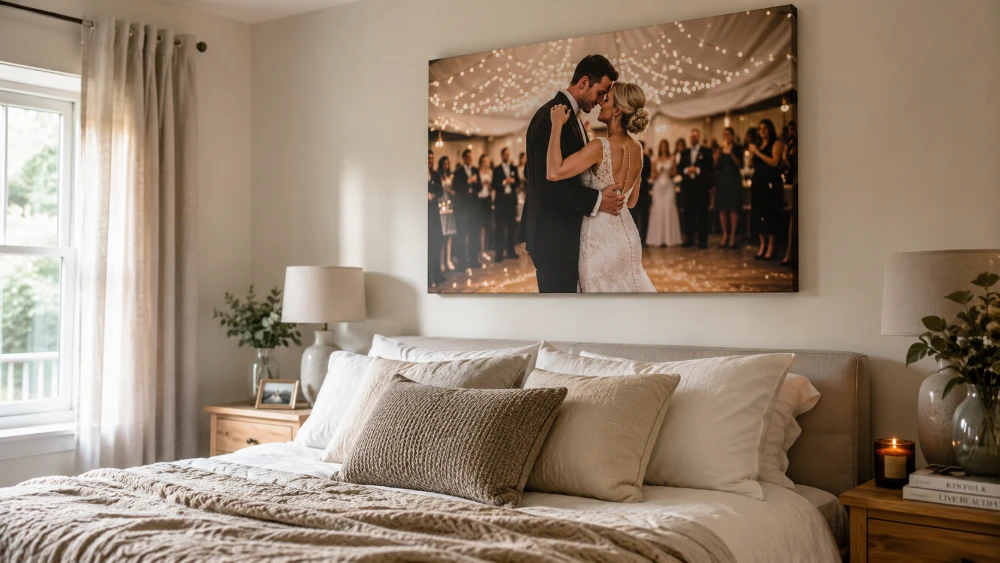
Before you do anything else, do this one thing. Pick the single best photo from your entire gallery — the one that still stops you when you scroll past it — and print it large.
Not 8x10. Not even 11x14. Print it at 16x20" minimum. For a focal wall, 20x30" or 24x36" is closer to right.
The reason this matters: one big print on a focal wall does more emotional work than twenty small prints scattered around the house. A small framed photo on a shelf is decoration. A four-foot canvas above your sofa is a statement. Both have a place, but if you only do one thing, do the big one.
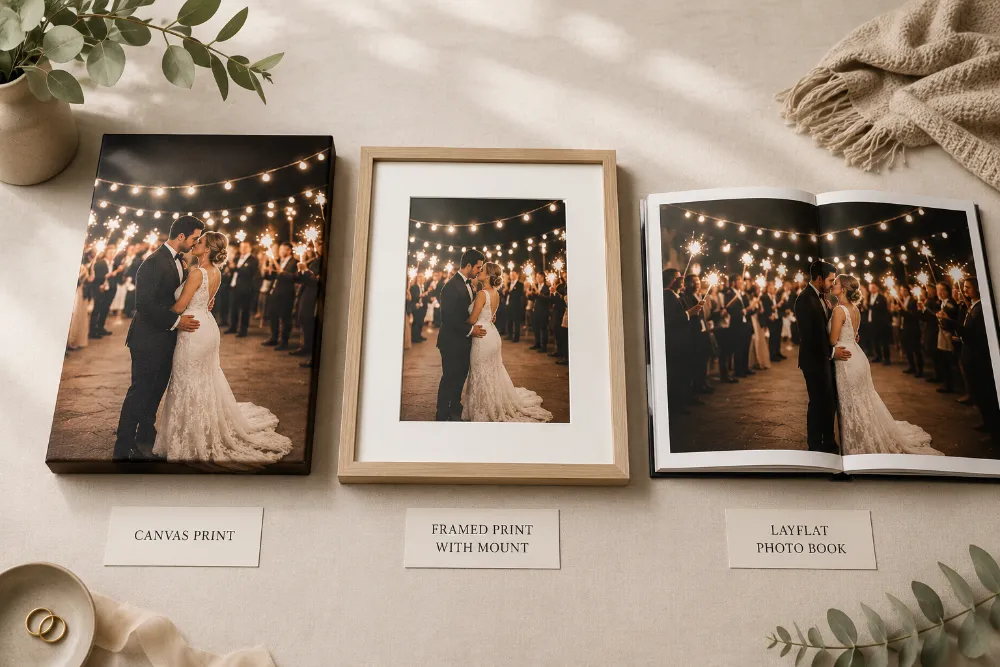
Canvas is the format I'd default to here — no glass to throw glare, no heavy frame fighting the image, and the woven texture forgives any harsh editing or strong contrast in the photo. Custom canvas prints work especially well in the 20x30" to 24x36" range.
If your home leans clean and modern — lots of white, concrete, light wood — acrylic suits better. The colors come out sharper and slightly luminous, and the print sits flat against the wall with a small float behind it. Detail shots (rings, lace, the bouquet) look incredible on acrylic in particular. One caution: acrylic reflects. Don't hang one directly opposite a south-facing window or you'll spend half the day looking at your own ceiling.
Sizing tip nobody tells you: the print should be roughly two-thirds the width of the furniture below it. Any smaller and it floats. Any bigger and it overwhelms the room.

Build a wall that tells the whole story
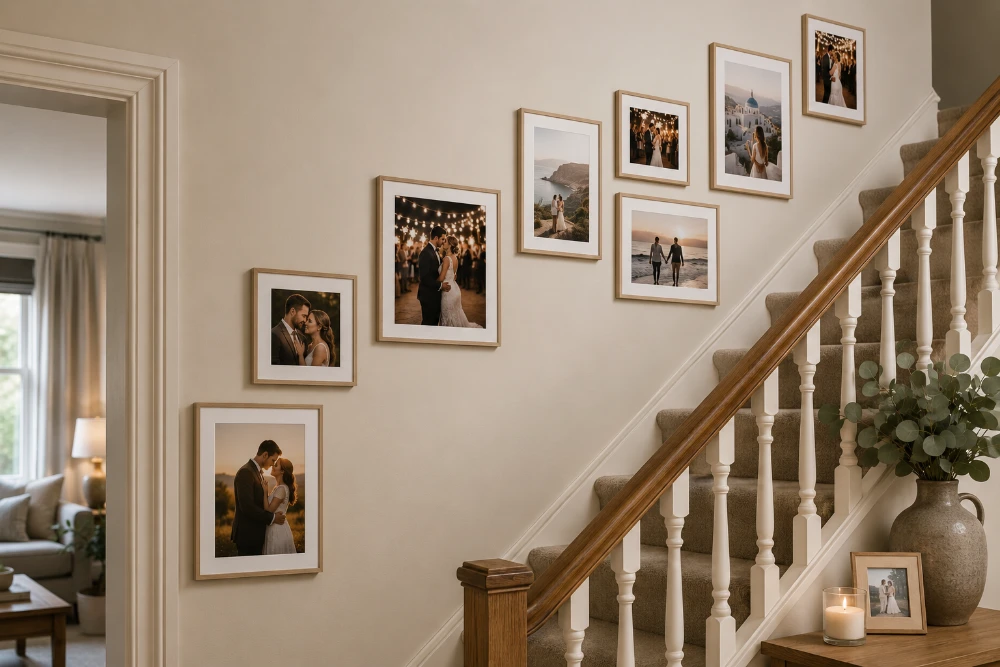
If the one big print is the headline, a wall of photos is the article underneath it. This is where you get into the texture of the day — the dance floor at midnight, your dad mid-speech, the kids fighting over dessert, the shoes lined up by the window before you put them on.
The classic mistake: identical frames in a perfect grid. That works for some homes, but it usually reads as a corporate boardroom rather than a love story.
The better version mixes everything. Sizes, orientations, frame finishes, photo types. One large anchor print, three or four medium ones, a couple of small detail shots tucked in close. Some portrait, some landscape. Some of you two, some of just the rings on the table runner. The variety is what makes it feel personal rather than staged.
If you want a real method for laying this out before you put a single nail in the wall, our step-by-step on how to make a gallery wall covers the paper-template trick — the thing that saves most people from re-hanging everything twice.
The detail collage (the format most couples skip)
Your photographer probably took dozens of detail shots — your rings on the lace runner, your shoes by the window, the bouquet propped on a chair, the menu cards, the vows pages, the place settings. Individually each one is a small thing. Together, they tell the story of the day in objects rather than faces.
A collage canvas lays out six to nine of these in a single print. It works as a piece of art that doesn't shout "wedding photo" the way a posed portrait does. Visitors notice it without really noticing it. For couples who want their wedding photos in the house but aren't keen on staring at them themselves on the wall every day, this is quietly the format.
Small corners that only you'll really notice
Not everything has to be big. Some of the most-loved wedding photos in any house are small, framed, and tucked into a corner that only the people who live there ever really see. The nightstand. The vanity. The wall above a reading chair. The bookshelf in the home office.
For these spots, a framed 5x7" or 8x10" works perfectly. The kiss photo, the moment one of you first saw the other, the laugh during the vows — these don't need to be three feet wide. Small and personal does the job. If you're trying to match a frame you already own or sizing a print to a frame you bought, our guide to standard picture frame sizes covers every common US size and which photo dimensions pair with which frames.
Standalone photo blocks for shelves and the mantel
If wall space is tight or your rental hates nail holes, you don't actually need walls at all. Standalone acrylic photo blocks — small thick cubes with a photo set inside them — are made for shelves, mantels, side tables, and the empty gaps between books.
They work because they're tactile. Guests pick them up. They catch light in a way flat framed prints don't. Group three or four together at different heights with mixed photo orientations, and they don't feel staged.
Take it off the walls: soft displays
Here's a slightly counterintuitive idea: not all wedding photo displays have to be flat objects you look at. Some of the warmest ones are soft — and these tend to be the ones that genuinely surprise people.
A photo blanket sounds tacky on paper, and it can be if you do it badly. But folded over the arm of a sofa or at the foot of a bed, a fleece blanket printed with one of your favorite wedding photos reads as warm and personal, not cheesy. The trick is photo choice. Black-and-white tends to look better than full color on fabric. A relaxed candid (the walk back down the aisle, a dance-floor laugh) works better than a stiff portrait.
Photo pillows follow the same logic. One or two on a window seat, a reading chair, or the foot of a bed — not a full sofa lineup, which starts to look like a hotel gift shop. Square 18x18", black-and-white, close-up shots like clasped hands or a quiet kiss — these photograph onto fabric particularly well.
Here's a real-world example of how couples are styling this in their own homes:
Displays that change with the years
Here's a problem nobody warns you about: any wedding photo display you set up in year one starts to feel slightly dated by year five. Your taste changes. Your home changes. New photos pile up that you wish you'd printed instead.
The fix is to build at least one display in your home that's designed to be refreshed.
A tabletop frame you update every anniversary
The simplest version: a frame on a dresser or mantel where the frame stays and the photo inside changes. Swap it every wedding anniversary. A new favorite each year — could be from the wedding gallery, could be from the past twelve months. The frame becomes a small annual ritual rather than a static piece of furniture that ages with you whether you like it or not.
Modular photo tiles you can rearrange any time
If a permanent gallery wall feels too final, modular photo tiles let you keep your options open. MIXPIX-style tiles are individual squares you arrange yourself, peel off the wall, and rearrange whenever you feel like it. Anniversary shots arrive next year — swap a few tiles. Honeymoon photos? Add them. Baby photos eventually? Work them in. The display grows with you rather than becoming a time capsule from one Saturday in October.
The coffee table photo book (not the formal album)
Here's something nobody admits: nobody flips through the formal wedding album. It's too big, too precious, too hard to get out of the cupboard. It sits there. Beautiful and unread.
A smaller, casual photo book — something around 8x8" or 10x10", hardcover, full of the candid stuff that didn't make the formal album — changes that. Leave it on the coffee table. Friends actually pick it up while they're waiting for the coffee. You flip through it on lazy Sundays. It gets used. Build a new one each anniversary if you want — a fresh chapter of the marriage every year.
A wedding-year calendar
Twelve favorite wedding photos, one for each month, hung above the desk or in the kitchen. Half display, half practical: it does decorative work AND tells you when the dentist is. The display refreshes itself every thirty days. It also makes a quietly perfect gift for parents and grandparents at the first Christmas after the wedding — print four of them, ship them out, done.
A few unexpected ideas worth considering
These don't fit neatly into the other sections, but they're worth knowing about.
A star map of your wedding date and venue
A personalized star map shows the constellations exactly as they appeared at a specific date, time, and location — so a custom map for the night you got married becomes a quiet, abstract reminder of the day. No faces, no posed shots. It hangs especially well in a bedroom and tends to start conversations with anyone who notices it. For couples who want something meaningful but slightly understated, it's a strong choice.
A wedding-photo jigsaw puzzle
Pick a busy photo with lots of detail — a wide reception shot, a complex bouquet, a candid with several people in it. Avoid mostly-white-dress-shots; you'll lose your mind on the blank sections. Do the puzzle together on a rainy Saturday afternoon. Mount the finished version on foam board and frame it. The story behind it ("we put this together one weekend") quietly becomes part of the photo itself.
Metal prints for tricky spaces
Sunrooms, covered patios, bright kitchens, hallways near a back door where wet coats live in winter — anywhere humid or sun-blasted that would slowly destroy a canvas. Metal handles it. Brushed-metal finishes lean vintage; glossy aluminum looks more modern. Pick based on the photo. Heavy-contrast black-and-whites look incredible on brushed metal.
A few things people learn the hard way
You don't really realize any of this until after you've hung the first batch:
- Don't try to display everything. Every one of those 800 photos will feel like it deserves a wall spot. It doesn't. Five great prints make more impact than twenty okay ones.
- Mix sizes. Same-size prints everywhere read as flat. One large anchor plus smaller supporting prints feels intentional.
- Black-and-white travels better. Color photos pick up the white balance of every room you'll ever paint. Black-and-white quietly matches everything. If you're torn between two prints, the B&W version usually wins for long-term display.
- Avoid direct sunlight. Even modern UV-protective glass slows fading rather than stopping it. The kiss photo isn't going on the wall opposite a south-facing window.
- Plan the room first, photo second. A wedding portrait above the dining table can feel a bit much during dinner parties. Bedrooms, hallways, the home office, the reading corner — those are the low-stakes spots where wedding photos sit comfortably.
Where to go from here
The real point of any of this isn't to commemorate the day. It's just to keep your wedding photos somewhere in your daily life — not in a folder on a hard drive you might open once a year on the anniversary. One big canvas above the bed, a handful of small framed shots on a shelf, or a calendar in the kitchen — the right display is the one you'll actually see.
Frequently Asked Questions About Wedding Photo Displays
-
No — but it can be if you only display posed portraits in identical gold frames in every room. The trick is mixing sizes, formats, and types of shots (detail shots, candids, and the occasional portrait), and treating wedding photos like any other meaningful art you'd hang rather than building a separate wedding shrine. If a photo would still feel right on the wall in five years, it's a keeper.
-
There's no rule, but most homes feel best with three to seven wedding photos total, spread across rooms rather than concentrated in one spot. A typical balance is one statement piece (a large canvas or framed print), one mid-sized piece, and a couple of small framed photos on shelves or nightstands.
-
Bedrooms, hallways, home offices, reading corners, and bedside tables work especially well — they're personal, low-stakes spaces. The main living room can carry one well-chosen statement piece. Dining rooms can feel intense (you're staring at yourself while eating), and kitchens are tricky unless the print is something durable like a metal or acrylic finish.
-
Lean on detail shots and candids over posed portraits. Mix them with non-wedding art — travel prints, abstract pieces, family photos — so the wedding pieces blend in rather than dominate. Black-and-white wedding photos in particular sit alongside other decor without competing with it.
-
Many couples refresh their displays each anniversary — swapping in a photo or two they didn't originally print. Modular options like photo tiles, calendars, or tabletop frames make this easy. If a display still feels right, leave it alone. If you walk past it daily and don't really see it anymore, that's the cue to swap something out.
-
Canvas suits casual or eclectic homes and works well at larger sizes (20x30" and up) where you don't want glass glare. Framed prints suit more traditional or formal interiors and tend to work better at smaller sizes (5x7" and 8x10") on shelves and nightstands. There's no wrong answer — most homes end up with a mix of both.
